
Accept logo-printed promotional toys only after the received cartons and sampled goods match the approved order specification under the buyer’s sampling plan. The receiving checklist should reconcile carton count, artwork version, logo position, packing quantity and retained samples, then record an accept, accept-with-exceptions, hold or reject decision. Set the comparison references and acceptance criteria before delivery; a signed sample alone does not define a numerical tolerance or prove that the shipment matches.
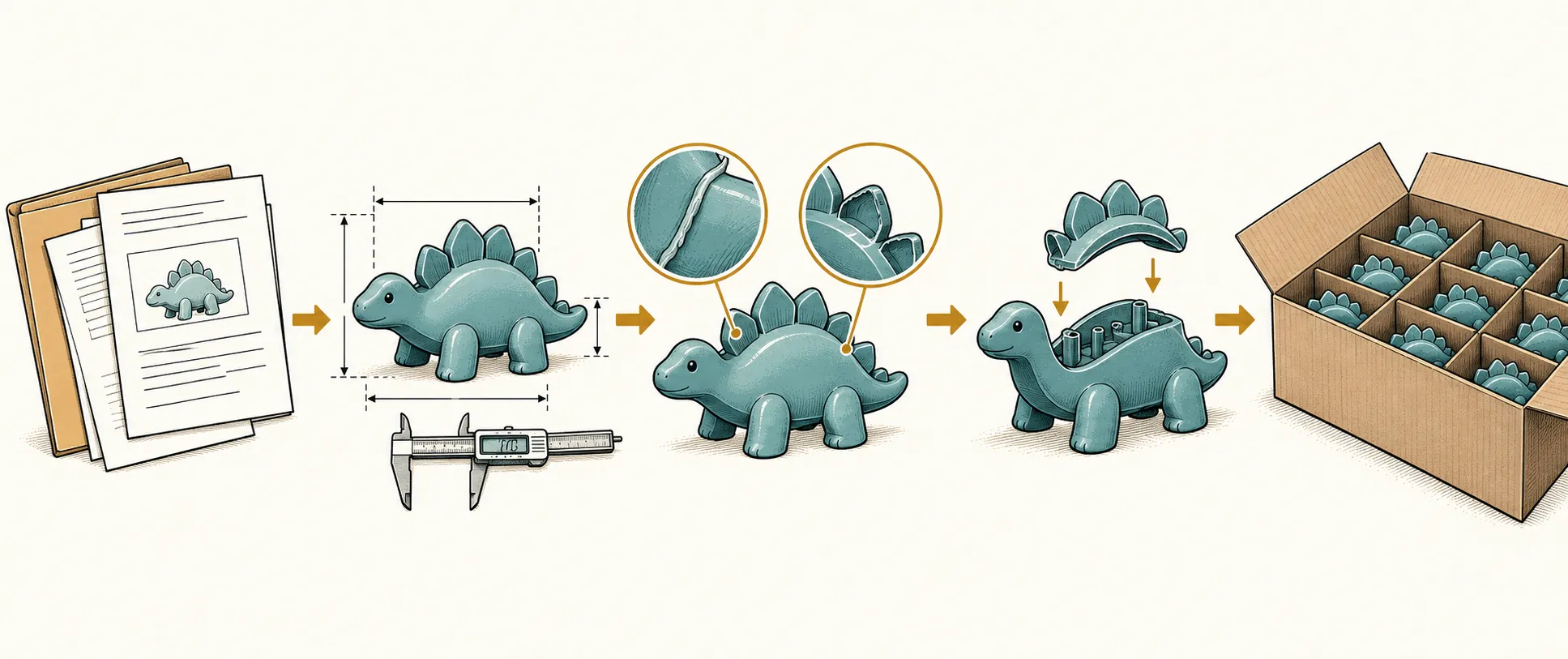
What must the buyer approve before the shipment arrives?
Freeze the product, quoted sales unit, color reference, logo process and location, packaging revision, packing specification and sample identity before production, then give receiving staff access to those records. Record the approval date and approver, not just an image buried in a message thread. Artwork approval should identify the final version, position, size, colors and package or label information. Custom Toy Order Timeline
The buyer should also define the inspection lot, carton-selection method, number of units to inspect, counting method, defect categories and decision thresholds. State whether a result applies to one carton, a defined sublot or the whole shipment. Do not let the receiver invent a threshold after finding a defect.
A digital proof controls layout and copy; it does not demonstrate the printed result on the toy’s surface. A blank toy sample does not establish final branding or packaging. Use an identified branded physical sample where print appearance matters, and a packed sample where fit or protection matters. A packaging PDF alone cannot prove physical fit. Custom Toy Sample Approval Checklist Custom Toy Packaging and Artwork Checklist
Which catalog packing facts need confirmation?
Use catalog packing fields to prepare the order specification, but receive against the final approved configuration—not an unchanged catalog page.
For example, the 3D-printed stress-relief toy listing records “Carton Quantity”: “200 pcs/carton”, “Carton Size (cm)”: “55 x 50 x 45”, and “Gross Weight per Carton (kg)”: “32.0”. These are catalog source values to reconfirm before the purchase order. Gross carton weight is not individual toy weight. 3D-printed stress-relief toy listing
Ask directly: “Confirm whether one catalog piece equals our quoted sales unit, the inner-pack configuration, and the final carton quantity after logo printing and individual packaging. Confirm available colors and quantities for this order, plus reorder conditions.” A listed color does not establish inventory or immediate shipment.
Keep the supplier item reference, quoted sales unit, pieces within a set, inner-pack count, carton quantity and MOQ separate. If the sales unit is a set, receive and count sets; do not silently substitute the number of components inside them. A carton quantity is not automatically an order multiple.
Hypothetical customization request CR-01
| Request identity and quoted sales unit | CR-01, revision 1; hypothetical PO DEMO-01. Request the selected 3D-printed stress-relief toy, quoted as one finished, logo-printed toy in one individual bag. Confirm the supplier item reference separately. Do not treat a bag, inner pack or carton as the quoted sales unit. |
|---|---|
| Color reference and acceptance boundary | Request blue matched to physical master COLOR-B1. Agree lighter and darker boundary samples COLOR-L1 and COLOR-D1, viewed at the designated receiving light station. Those approved boundaries define the proposed visual color tolerance; a monitor image is not the acceptance reference. |
| Logo artwork, process and placement | Request pad printing, subject to supplier confirmation for the selected surface. Artwork LOGO-r03; logo size 20 × 8 mm with a proposed ±1 mm tolerance on each dimension. On the approved print face, locate the logo’s top edge 15 mm below the marked product datum, with a proposed ±2 mm tolerance. Record orientation on the proof photograph. |
| Packaging artwork and wording | One toy per bag with insert PACK-r02. Buyer-required campaign wording: “Campaign play”. Match all other buyer-approved copy, barcode data and label placement to the signed packaging proof. Confirm any required destination-market wording separately before artwork approval. |
| Final packing specification | PACKSPEC-r01: 200 individually bagged sales units per carton, no inner packs, one approved color. Reconfirm this configuration after the final packaging is approved; do not carry the catalog carton quantity forward without confirmation. |
| Approved sample and production release | Retain branded, packed sample MASTER-01 at QA cabinet A, shelf 2. Its record links LOGO-r03, PACK-r02 and PACKSPEC-r01. Hypothetical approval: A. Lee, buyer QA approver, November 6, 2026. Sample approval identifies the reference; the written tolerances remain separate. |
| Buyer-defined sampling and acceptance | Treat the two-carton shipment as one receiving lot. Count the contents of both cartons. Randomly select five toys from each carton for logo, color, packaging and visible workmanship checks. Proposed acceptance number: zero observed deviations in those checks. Any deviation holds the lot for authorized disposition; do not keep drawing samples until it passes. |
| Change control before production | Record any proposed product, color, print-process, artwork or packaging change against CR-01. Obtain buyer approval and decide whether a new proof, sample, packing specification or quotation is needed before release. |
Completed hypothetical receiving checklist
| Receiving record identity | Record REC-DEMO-01, revision 1; PO DEMO-01; lot LOT-DEMO-A; received November 12, 2026. Inspector: J. Chen, fictional receiving inspector. References: CR-01 revision 1, LOGO-r03, PACK-r02, PACKSPEC-r01 and MASTER-01. |
|---|---|
| Carton count, sequence and labels | Target: two cartons on the final packing list. Observed: two cartons received, marked 1 of 2 and 2 of 2. Product reference, PO and stated quantity reconcile with the packing list. Photo references: CARTON-01 and CARTON-02. |
| External condition | Target: record damage and investigate any suspected effect on contents. Observed: no visible external damage in this hypothetical receipt. Carton-condition photographs retained. |
| Sales unit and packing quantity | Target: one bagged toy per sales unit; 200 sales units per carton; no inner packs. Observed: both cartons fully counted at 200 bagged toys each, with no inner packs. Result: matches PACKSPEC-r01. |
| Sampling performed | Target: five randomly selected toys from each carton. Observed: ten toys inspected in total, identified C1-U1 through C1-U5 and C2-U1 through C2-U5. The full packing count and the sampled appearance checks are recorded separately. |
| Artwork version and print appearance | Target: visible content matching LOGO-r03, correct orientation, legible text and no visible logo smears. Observed: all ten inspected toys match the approved artwork content and orientation, with legible, unsmeared logos. This visual comparison does not independently establish which production file the printer used. |
| Logo size, color and position | Target: size within the proposed ±1 mm limits; color within approved boundary samples; top edge 13–17 mm below the defined datum. Observed: all ten meet size and color criteria. Nine measure 15 mm for placement; C2-U4 measures 19 mm. Exception EX-01 includes a measurement photograph and unit identifier. |
| Packaging artwork and wording | Target: PACK-r02 insert and approved copy, including “Campaign play”. Observed: all ten sampled packs match the approved layout and wording. Result: pass for the sampled packaging check. |
| Retained samples and storage | Approved reference MASTER-01 remains at QA cabinet A, shelf 2. Received-lot sample C1-U1 and deviation sample C2-U4 are retained separately in QA hold bin H1, labeled with PO, lot, receipt date, receiving decision and EX-01 where applicable. |
| Decision and authorized sign-off | Decision: HOLD the entire receiving lot because one sampled logo position exceeds the agreed limit and the proposed acceptance number is zero. No inventory release. Authorized by A. Lee, fictional buyer QA approver, November 12, 2026. |
| Notification, follow-up and closure status | Supplier notified November 12, 2026 under EX-01, with photographs, measurement and affected carton/unit identifiers. Requested action: propose a correction and define its scope for the held lot. Status: OPEN. Owner: A. Lee. Follow-up due November 13, 2026. Closure date and evidence remain to be entered after the agreed action is completed and verified. |
When should the buyer accept, hold or reject the lot?
Accept only when the recorded results meet the pre-agreed criteria; hold when a deviation or unresolved identity issue requires a decision before release.
Accept with exceptions only when an authorized buyer records the exact deviation, affected quantity or scope, reason for concession and any conditions. Do not quietly widen a placement or color tolerance after inspection. Preserve the original criteria and record the concession separately.
Reject when the buyer’s authorized disposition declines the goods under the agreed order terms—for example, after a wrong-artwork finding and review of available remedies. Keep rejected or held stock identified and separate from released inventory. A label mismatch warrants reconciliation; it does not by itself prove that the contents are wrong.
The hypothetical zero-deviation rule above is a buyer-selected commercial screen, not a compliance standard or a prediction of the return rate. Sample approval defines the reference but does not prove that every bulk unit matches; production QC and pre-shipment inspection remain separate controls. This receiving checklist is not a substitute for applicable safety testing or document review. Custom Toy Sample Approval Checklist
What closes a receiving exception?
Close an exception only after recording the agreed action, verification evidence, closure date and authorized final disposition. A supplier reply is not, by itself, evidence that held goods have been corrected.
For rework or replacement, identify what was changed, which cartons or units were affected and what follow-up inspection established. For an agreed credit or concession, retain the written agreement and inventory disposition. Every unresolved exception needs an owner and next review date.
Keep the approved master distinct from received-lot and defect samples, with storage locations and retention periods set by the buyer. If color, branding method, product construction or packaging changes, update the change record and decide whether a new proof, sample or other review is needed. Custom Toy Sample Approval Checklist
The record supports traceability; it cannot by itself expose an undisclosed production change. Its practical value is narrower and useful: the buyer can show what was ordered, what was checked, what differed and who authorized the final decision.