
Release toy logo artwork only when one approval record identifies the exact product, controlling file revision, decoration instructions, packaging layout, approver, date, and unresolved conditions. The practical decision is whether to release that revision, request a corrected proof, or hold production for physical evidence. A signed PDF can approve visual instructions; it cannot establish ink adhesion, physical color matching, packaging strength, product function, or compliance. Keep those decisions separate, but link their evidence in the same record.
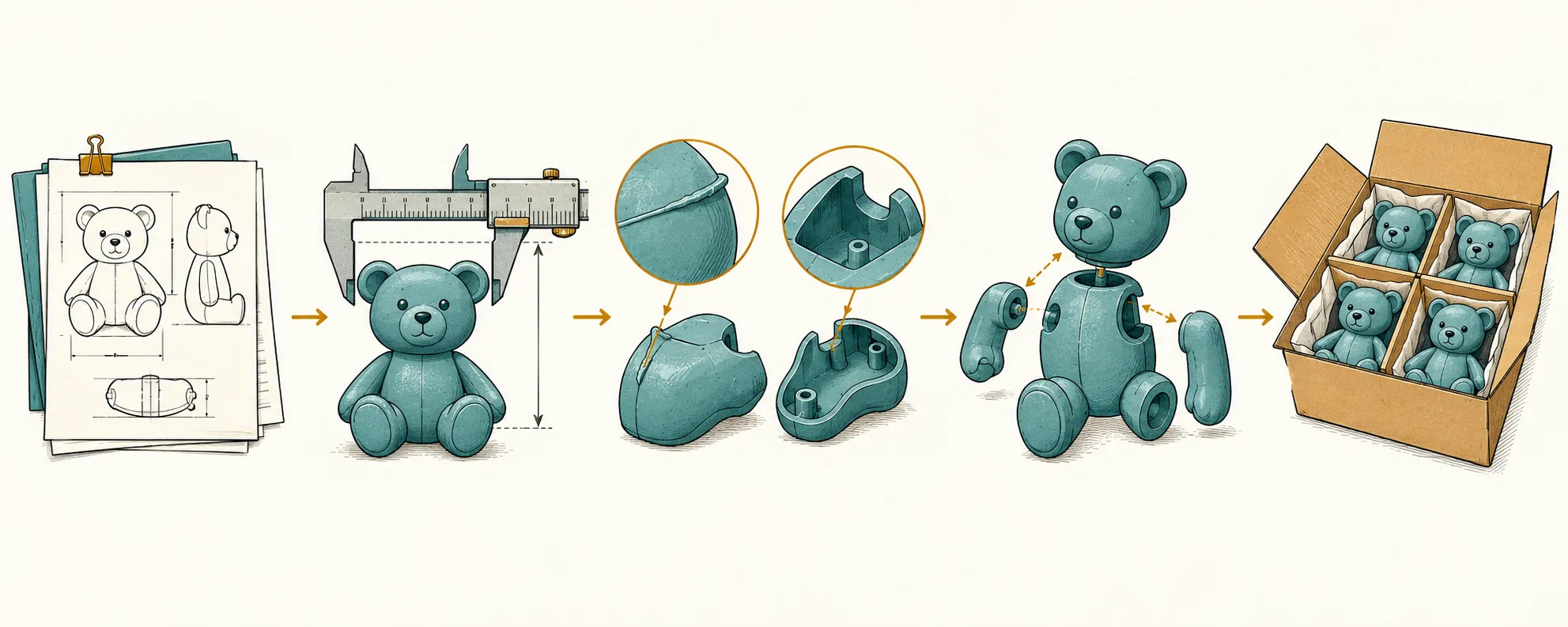
What does an artwork approval prove—and what needs separate evidence?
| Logo and printed information | The proof can record artwork version, position, size, orientation, color references, text, and barcode or QR placement. Final appearance, adhesion, and physical color matching need separate checks. |
|---|---|
| Packaging artwork | A dieline or PDF can show layout, copy, folds, cut areas, and artwork position. It does not establish assembled fit, transit protection, or shelf presentation; use a physical packaging or packed sample where those properties matter. |
| Product and test status | Artwork approval does not confirm material feel, dimensional tolerance, function, compliance, or laboratory-test results. Link the relevant sample, specification, inspection, or test evidence separately. |
Which product, color, logo, and packaging choices must be settled first?
Settle the product and quoted sales unit before asking a printer to turn the logo into production artwork. Record the supplier item reference, selected version, contents of each sales unit, and packaging configuration independently of the carton count.
For an existing-color route, request the available colors, current availability, and reorder conditions for the exact item. A catalog color is not an inventory commitment. Choose a custom body color only when that color is part of the brief, and obtain its own confirmation rather than applying a base-product MOQ to it.
Choose logo-on-label packaging when the branding requirement belongs on the package; choose direct decoration when the logo must remain on the toy after unpacking. For direct decoration, confirm the quoted process, printable area, and sample route for that surface. Neither route should be assumed available merely because a product appears in a catalog.
Prepare the final logo file and preview, color reference, position, size, orientation, complete copy, barcode or QR payload, and package or label layout. Ask the chosen printer to confirm its accepted file format, template, bleed, and safe areas. Do not carry a previous printer's settings into a new job.
Keep product, decoration, and packaging minimums separately identified in the quotation, then establish which confirmed constraint governs the selected configuration. A package can have a different production minimum from the toy. Packaging Artwork Checklist
Zebra-stripe bun squishy: catalog packing reference
| Product Size | 8.5 x 8.5 x 5 cm |
|---|---|
| Carton Quantity | 288 pcs/carton |
| Carton Size (cm) | 57 x 56.5 x 43 |
| Net Weight per Carton (kg) | 14.0 |
| Gross Weight per Carton (kg) | 16.0 |
What must the quotation confirm for this catalog example?
Request written confirmation of whether the quoted sales unit is one toy, a display pack, or another defined configuration, including the contents of that unit. The product name's reference to a display box does not settle the commercial unit.
Reconfirm the recorded packing for the selected configuration before the purchase order. The carton quantity is not automatically an order multiple, and carton net or gross weight is not verified individual-toy weight. Request available body colors, the proposed logo process, package contents, and reorder conditions against the same product reference.
Hypothetical worked record: one logo on a package label
| Record identity and controlling revision | Record: LABEL-BRIEF-A, revision B. Controlling proof: bun-label_revB.pdf. Target: one complete proof bundle. Hypothetical observation: the review bundle identifies revision B on the proof and decision page. |
|---|---|
| Product and quoted unit | Product reference: zebra-stripe bun squishy catalog page linked above. Requested unit: one toy with its agreed labeled package. Target: supplier confirmation of item reference, contents per sales unit, and packing. Observation: confirmation remains open; no purchase quantity or price is approved. |
| Body color and availability | Target: retain the body color of the physical reference to be agreed; no custom body color authorized. Observation: body-color reference and availability are not yet confirmed. Action: obtain the selection, availability, and reorder terms in writing. |
| Logo source and permitted process | Source asset: program-logo_revB.svg, with matching preview. Target: one black logo printed on a white package label. Observation: the hypothetical proof uses that asset. Direct printing on the toy is outside the approval scope. |
| Logo location, size, and orientation | Target: upright, centered within the labeled front-panel artwork area, at the locked size shown on template LABEL-A_revB. Observation: visual placement is accepted in the hypothetical proof. The dimensioned production template and feasible manufacturing tolerances still require confirmation. |
| Color reference and acceptance limit | Target: black logo on white label stock, with a physical print reference to be agreed. Observation: the PDF shows the intended color assignment only. No numerical color tolerance is authorized. If a measured match is required, agree the reference, measurement conditions, and acceptance limit before release. |
| Text and required wording | Target: use COPY-A_revB verbatim; promotional wording is 'PLAY TOGETHER'. Observation: that wording matches the hypothetical proof. Any required product or label wording needs approval by the responsible buyer reviewer before production; no conformity marks are authorized by this artwork decision. |
| Barcode and QR data | Target: no barcode or QR code in this illustrative configuration. Observation: neither appears in revision B. Adding either requires a revised proof identifying the exact payload, printed size, and location, plus an appropriate final-print readability check. |
| Package and label layout | Target: template LABEL-A_revB, with the front panel, application area, cut boundary, and protected text area identified. Observation: the hypothetical visual layout is accepted. Package format, label stock, sealing method, and physical application remain subject to confirmation. |
| Physical sample reference | Reserved sample reference: PACK-SAMPLE-A, not an approved sample. Target: a packed sample showing body color, label position, assembled fit, and presentation. Observation: no sample approval is recorded; physical checks remain open. |
| Approval identity, date, and scope | Illustrative approver: Buyer Artwork Owner. Illustrative date: October 28, 2026. Decision: approve revision B's logo asset, promotional wording, and visual layout only. This is not permission to manufacture, print packaging, or pack goods. |
| Release conditions and responsible owners | Supplier Project Contact: confirm sales unit, item reference, available body color, decoration route, and package specification. Buyer Packaging Approver: review the packed sample. Buyer Label Reviewer: approve final wording. Buyer Production Approver: close the conditions and record the release decision. |
| Follow-up closure | Production status: HOLD. Each owner must enter the response date, linked evidence, and accepted or rejected result. Reissue the proof if confirmation changes the artwork. The production approver must then record the controlling revision, release scope, signature, and date. |
| Supersession entry | In this hypothetical revision history, revision B replaces revision A following a logo-asset correction. Mark revision A superseded and withdrawn from printing permission. Require supplier acknowledgment that revision B is the current review file; production remains on HOLD. |
When does a physical sample become a release condition?
Make a physical sample a release condition when the decision concerns a property the proof cannot establish, such as printed color on the actual surface, adhesion, label application, or assembled package fit. Define the property being checked and its acceptance criterion beside the sample reference.
A signed sample supplies a physical reference; it does not silently create a numerical tolerance. If logo dimensions or color variation require measured acceptance limits, agree the measurement method and limits explicitly. A packaging sample can support a fit decision without establishing transit protection or product compliance. Packaging Artwork Checklist
In the worked record, the next useful action is not another logo screenshot. It is confirmation of the commercial configuration and the physical packaging evidence needed to close the HOLD.
What changes require a new proof and approval?
Any post-approval change to the logo, text, barcode data, insert, layout, or package structure should create a deliberate new revision, not an informal instruction to replace one element. Keep one current packaging revision tied to the exact product reference, artwork file, dieline, approval date, and sample reference. Packaging Artwork Checklist
Mark the earlier approval superseded, withdraw permission to print that file, issue the complete revised proof, and obtain a new approval for the replacement. Record who requested the change, what changed, which revision it replaces, and the supplier's acknowledgment. Reassess whether the change needs a new sample, quotation, or schedule review. Artwork Proof Approval Checklist
Release production only when the controlling revision is unambiguous, the approval scope and approver/date are recorded, and required evidence is accepted. A non-blocking commercial exception may remain open only with a named owner, explicit acceptance, and a closure condition; do not use an exception to waive required safety or compliance evidence.
The record provides traceability. It does not, by itself, prevent or reveal an undisclosed production change. Ask the supplier to acknowledge the current revision and use appropriate sample or inspection checks to compare actual output with the approved instructions.