
Squishy Toy Bulk Buying Desk · Updated 14 October 2026
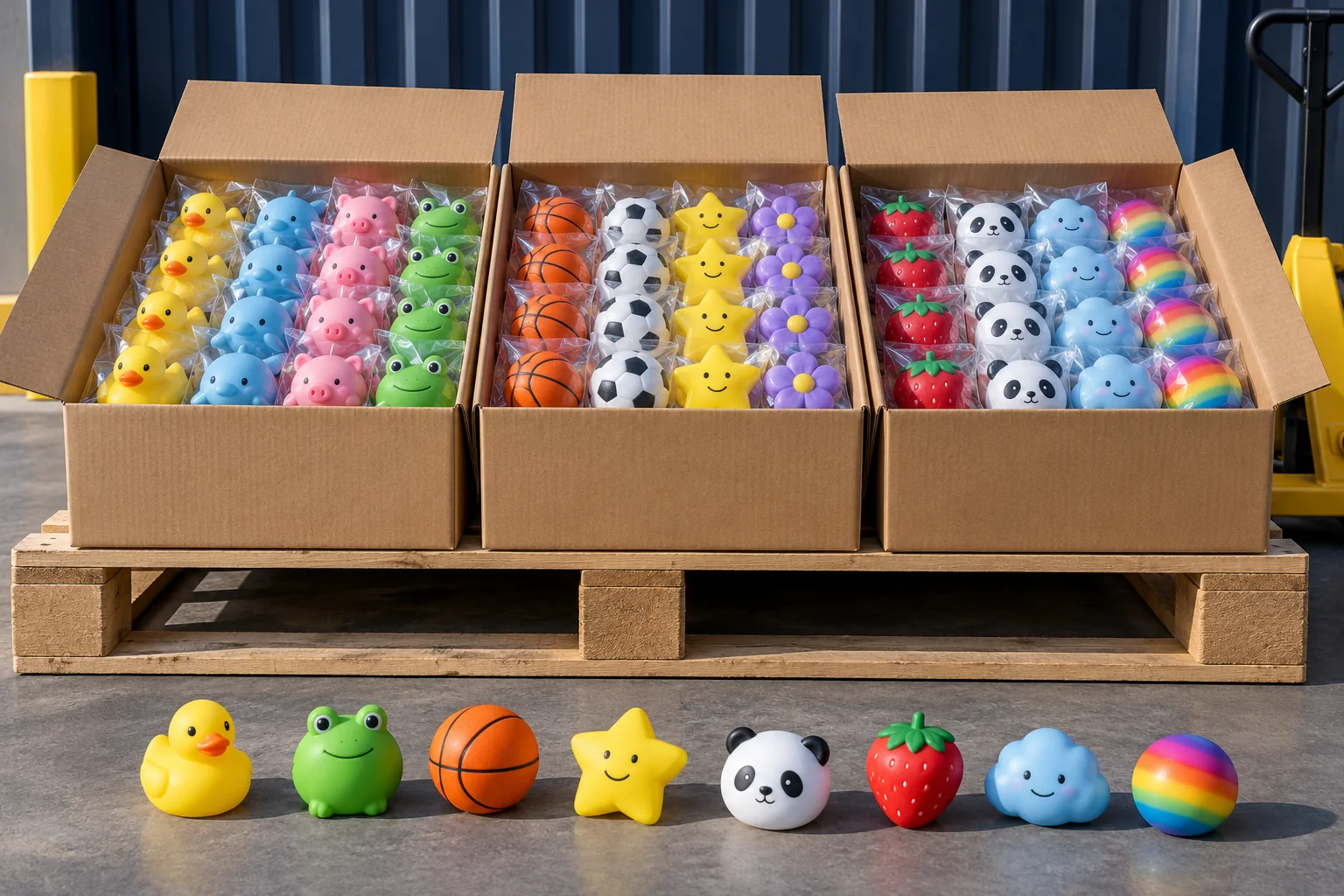
A container quote starts with measured cartons. Product dimensions help select the item; external packed-carton dimensions, gross weight and stacking constraints help plan the shipment. Keep these measurements in separate columns when comparing bulk squishy toys and larger activity sets.
Build a carton-level worksheet
For every SST item, record sale units per carton, external carton length, width and height, gross weight, proposed carton count and pallet requirements. If the retail pack changes, request a new carton sheet. Do not use the dimensions of a loose toy to calculate container capacity.
Carton CBM = length × width × height in metres.
Shipment CBM = sum of carton CBM × carton count for each SKU.
Order units = sale units per carton × carton count.
Worked example: arithmetic only
Suppose an illustrative carton measures 0.50 × 0.40 × 0.30 m and contains 100 sale units. Its volume is 0.06 m³. Two hundred cartons represent 20,000 units and 12 m³ of carton volume. These are invented worksheet inputs, not a specification or packing promise for any catalog item.
That calculation does not establish how many cartons fit a 40HQ. Actual loading must account for container equipment, usable geometry, weight limits, carton orientation, pallets and stacking restrictions. Obtain a loading proposal and confirm it with the responsible shipping parties.
Round the order deliberately
If an order quantity does not divide into the approved carton count, identify the remainder. Compare a full-carton adjustment with a part-carton pack if available. Mixed designs, counter displays and complete calendar sets can introduce additional packing multiples.
Build the landed-cost column
| Budget component | Record beside the amount |
|---|---|
| Goods and decoration | Currency, units, artwork and packing revision |
| Fixed development costs | Samples, setup, tooling or dielines where applicable |
| Origin and main transport | Delivery terms, named place and included charges |
| Destination costs | Broker-confirmed import charges and local delivery scope |
| Receiving and distribution | Warehouse handling and onward release requirements |
Add the applicable costs and divide by the sale units being purchased to build a planning unit cost. Keep recoverable taxes, currency assumptions and estimates identified with your finance or import team. A goods-only EXW reference is not a landed price.
Compare a mixed load without hiding complexity
Use a separate row for every pack configuration. A squeeze-toy display, magnetic construction set and advent calendar can have very different carton footprints. All six catalog categories can participate in a consolidated order, but each still needs its own sample, packing sheet and quantity allocation.
What to send for the loading quotation
Submit the shortlisted SKUs, quantities per variant, destination, desired receiving date and pallet rules. Ask for carton totals, gross weight, loading assumptions and the quote validity. Sourcing inside Chenghai — one of the world's largest toy clusters — and a desk with 20+ years of export experience is what makes a tight mixed-container plan realistic. Start with the full catalog and request the container purchasing brief when the allocation is ready.
Frequently asked questions
What does CBM mean?
Cubic metres. Carton CBM is length × width × height in metres; shipment CBM is that value multiplied by carton count and summed across SKUs.
Why can’t product dimensions be used for container planning?
Because shipping uses the external packed carton, gross weight and stacking rules, not the size of the loose item. Request a carton sheet for the final pack.
Is EXW the same as landed unit cost?
No. EXW is goods at origin only; landed cost adds transport, insurance, import charges, duties and delivery depending on the agreed terms.
How is the final 40HQ quantity decided?
Against a loading proposal based on measured cartons, weight limits, pallets and container geometry — not a fixed number of toys.