
Choose a capsule shell only after its closure, filled-shell handling and refill workflow pass an agreed physical trial—not because its nominal diameter appears large enough. Treat 45, 50 and 65 mm as RFQ size options, then confirm usable space, seam clearance and the exact toy’s fit separately. Shortlist shells that suit the intended equipment and operator workflow; approve the shell specification and toy combination as separate decisions, with the sale unit and packing written into the quotation.
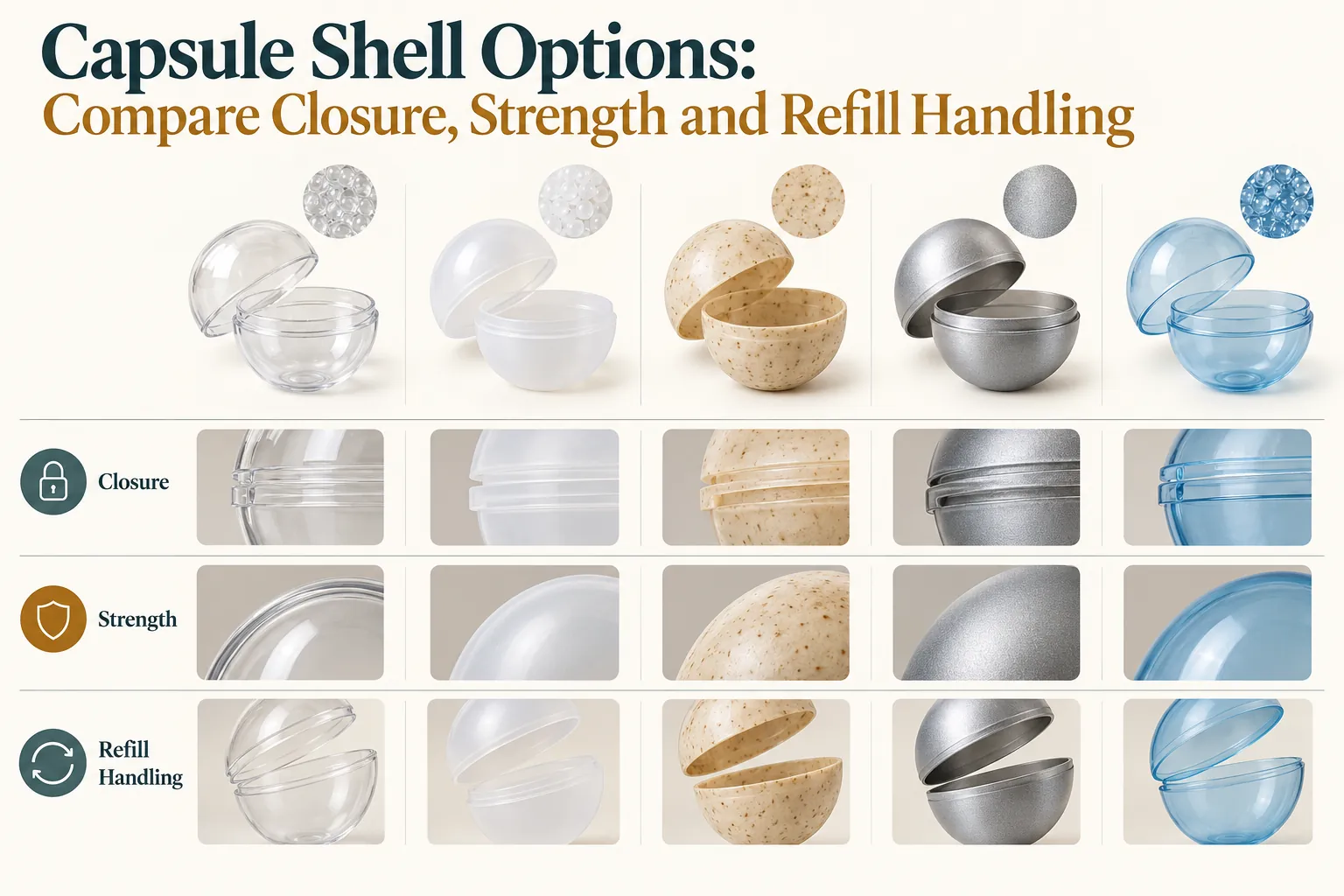
How should buyers compare 45, 50 and 65 mm capsule options?
| 45 mm nominal option | Use 45 mm as the RFQ size designation. Confirm usable internal space, seam clearance and the specific fill on a physical sample; do not treat 45 mm as an internal diameter. |
|---|---|
| 50 mm nominal option | Evaluate the sampled construction independently. A toy’s fit in another nominally 50 mm shell does not establish fit in this shell. |
| 65 mm nominal option | Request the same physical fit checks rather than assigning a universal fill volume. Confirm the intended equipment can handle the actual closed shell. |
| Selection boundary | A successful physical fit confirms the tested combination under its trial conditions; it does not establish age grading or small-parts compliance. |
Which closure design should buyers shortlist?
Shortlist the closure that operators can fully engage and verify without trapping the contents or leaving an uncertain seam. Compare the actual engagement mechanism rather than choosing from a closure name alone.
For press-fit or snap-engaging samples, inspect how the halves align, where pressure must be applied and whether the seam seats completely around the shell. Record false starts, repeated pressing and reopening during handling. An audible click can be an observation, but it should not be the sole acceptance criterion.
For twist-engaging samples, if offered, check alignment, the closing movement and the fully seated position. Observe whether the operator can distinguish a complete closure from a partially engaged one without repeatedly checking it.
Choose the option with repeatable engagement and acceptable retention in the intended workflow. Do not assume that a tighter-feeling closure is stronger, or that an easier-opening shell will remain closed during refill handling.
How should shell strength be checked on samples?
Compare shell strength under the same agreed conditions, assessing shell-body damage separately from closure release. A shell can retain its shape while its halves separate; those are different observations and need separate decisions.
Before testing, specify the sample quantity, empty or filled condition, contents, orientation, handling sequence and acceptance criteria. If compression or drops are relevant to the intended operation, agree the loading method or drop conditions in advance rather than improvising a harsher test for one candidate.
Inspect for cracking, permanent deformation, seam opening and damage to the contents. Repeat the closure check after handling. Where reopening is part of the intended operation, include that step; do not assume every shell is intended for repeated reuse.
Treat these as buyer-defined commercial screening checks, not safety tests or a universal strength rating. Results describe the samples and conditions tested; they do not predict a return rate or establish the performance of every production unit.
What should an operator refill trial measure?
A refill trial should measure the complete handling sequence, including sorting, filling, closing, checking and transferring capsules—not closing speed alone.
Use the intended operator setup and the same task boundaries for each candidate. Record elapsed time alongside completed capsules, closure rework, spilled contents, mismatched halves and interruptions. If one trial includes unpacking and another starts with neatly arranged halves, the timings are not comparable.
A useful calculation is: observed seconds per accepted capsule = total trial time in seconds ÷ capsules accepted after inspection. This is a trial metric, not a promised production rate; retain rework and sorting time in the numerator.
Specify pack segregation by nominal size, closure design and revision. For loose halves, identify matching components on the inner-pack labels and use separate bench bins. For matched sets, confirm how the sets are supplied and opened for filling. Keep rejected or unmatched components out of the refill stock.
For vending use, include the actual filled capsule in an equipment trial. Passing a hand-closing check does not establish that the capsule will feed and dispense correctly.
What sale unit and packing must the quotation identify?
The quotation should state whether the buyer is purchasing an individual half, a matched empty shell set or a filled capsule, then describe the packing for that exact sale unit. Do not let “piece” carry several meanings across the quote, sample label and purchase order.
Request inner-pack and carton counts, whether halves arrive paired or separated, and how sizes, closures and revisions are segregated. Record any agreed assortment explicitly. A carton quantity is a packing fact, not automatically an order multiple.
Keep catalog packing fields attached to their original product. For example, the telescopic suction-cup giraffe toy listing records “Package Size (cm)” as “21 x 17 x 5 cm” and “Gross Weight per Carton (kg)” as “0.5 kg.” Those are packaged-product and carton fields—not dimensions or unit weight for an unwrapped capsule fill. Telescopic giraffe catalog
Reconfirm the quoted packing before the purchase order. Neither a toy’s retail package dimensions nor its carton mass establishes which empty shell to buy.
Where does shell approval end and toy-fit approval begin?
Shell approval covers the identified shell construction, closure behavior, agreed handling checks and packing; toy-fit approval covers one specified fill combination inside that shell.
For the fit trial, identify the toy revision, insert and preparation method. Check projecting features and the item’s dimensional extremes in several orientations. Verify that nothing enters the mating seam, that the closure seats without forcing the toy into place and that the contents remain acceptable after the handling trial.
Keep the decisions separate. A shell may pass its empty-shell checks but fail with a particular toy and insert. Another toy may fit the same shell successfully. Approval of either combination should not be extended to an entire toy assortment without checking its members.
Record the exact scope of approval, including any required orientation. Fit alone does not establish age grading or small-parts compliance.
What does a completed comparison and approval record look like?
| Record identity and revision | Illustrative record: Shell Comparison A, revision 1. Candidate A: 50 mm nominal, press-engaging sample A1. Candidate B: 65 mm nominal, twist-engaging sample B1. Fill: Toy T, revision 1, with Insert I, revision 1. |
|---|---|
| Specified target: closure and shell handling | Both candidates must seat fully, retain closure during the agreed filled-shell handling sequence and show no cracking or permanent deformation in that sequence. |
| Illustrative shell observations | A1: seam fully seated and remained closed; no cracking or permanent deformation observed. B1: closure fully engaged and remained closed; no cracking or permanent deformation observed. Both pass the example shell-screening criteria only. |
| Specified target versus observed toy fit | Target: Toy T and Insert I must clear the mating seam without forced compression. A1 observation: the insert entered the seam in the intended orientation; fit rejected. B1 observation: the toy and insert cleared the seam and the closure seated; fit accepted for the recorded orientation. |
| Refill handling target versus observation | Target: complete engagement must be verifiable during the agreed bench sequence. B1 observation: the operator completed alignment, closure verification and transfer without reopening in the illustrative trial. No production-rate claim is assigned. |
| Actual sale unit and recorded packing | Example sale unit: one matched empty two-piece shell set. Packing method: separate labeled inner packs for each nominal size and closure revision. Inner-pack and carton counts remain a written-quotation condition before purchase-order release. |
| Decision and item-specific limits | Approve B1 as the reference shell sample and approve its fit with Toy T revision 1 plus Insert I revision 1 in the recorded orientation. Retain A1 as shell-screening acceptable but reject it for this fill. Do not extend B1 approval to other toys, inserts, closure revisions or equipment. |
| Responsible approvers and date | Illustrative approval dated October 28, 2026: quality lead approves the shell-screening result; operations lead approves bench handling; buyer records the item-fit scope and purchasing conditions. |
| Follow-up and closure | Open conditions: buyer obtains written pack counts; operations lead completes the intended equipment trial before purchase-order release. Each owner records the result, supporting document reference and closure date. Sample approval is complete; purchase-order release remains on hold until those conditions are closed. |
Which capsule shell should reach the purchase order?
Put the shell that passes the intended handling, exact-fill and equipment trials on the purchase order—not the option with the largest nominal size or firmest hand feel.
Reference the approved sample and revision, closure design, sale unit, packing agreement and item-fit scope. If several candidates pass, use the recorded refill observations to choose the one that creates less sorting and closure rework in your operation.
Retain the reference sample and check incoming goods against it and the agreed specification. The approval record supports traceability; it does not, by itself, detect an undisclosed construction change.