
Proceed to an RFQ for the 182-piece construction kit, but release a chain-store order only after its itemized parts list, complete-kit sale unit and packing configuration agree. Checking a construction kit's parts list means separating three quantities: components inside each kit, kits being purchased and kits packed per carton. The catalog's 182-piece description and “Packaging: Single item” support a kit-level inquiry; they do not establish a component breakdown, carton quantity or suitability as loose capsule fillers.
What does the 182-piece construction kit catalog actually record?
| Material | Plastic |
|---|---|
| Packaging | Single item |
| MOQ | 182 pcs |
| Wholesale price | US$2.7 / pc (EXW, tiered by quantity) |
| Package Size (cm) | 50 x 35 x 20 cm |
| Gross Weight per Carton (kg) | 3.0 kg |
How should buyers separate parts count, sale unit and order quantity?
| 182-piece product description | Interpretation: advertised components within one kit. Check: obtain the itemized quantities and the counting convention used to reach 182. |
|---|---|
| Packaging: Single item | Interpretation: an individual catalog item, not a loose-parts assortment. Check: confirm that one purchased unit contains the complete kit and identify its supplied packaging. |
| MOQ: 182 pcs | Interpretation: the catalog's minimum-order field. Check: confirm the unit of measure; do not treat this as carton quantity or an order-multiple requirement. |
| US$2.7 / pc | Interpretation: the catalog's EXW, quantity-tiered price wording. Check: obtain a quotation that states the complete-kit unit, applicable quantity tier and included packaging. |
| Loose capsule fillers | Buying distinction: an individually dispensed component is not equivalent to a complete construction kit. Do not use the kit's 182-piece count as evidence of 182 independently saleable or capsule-compatible fillers. |
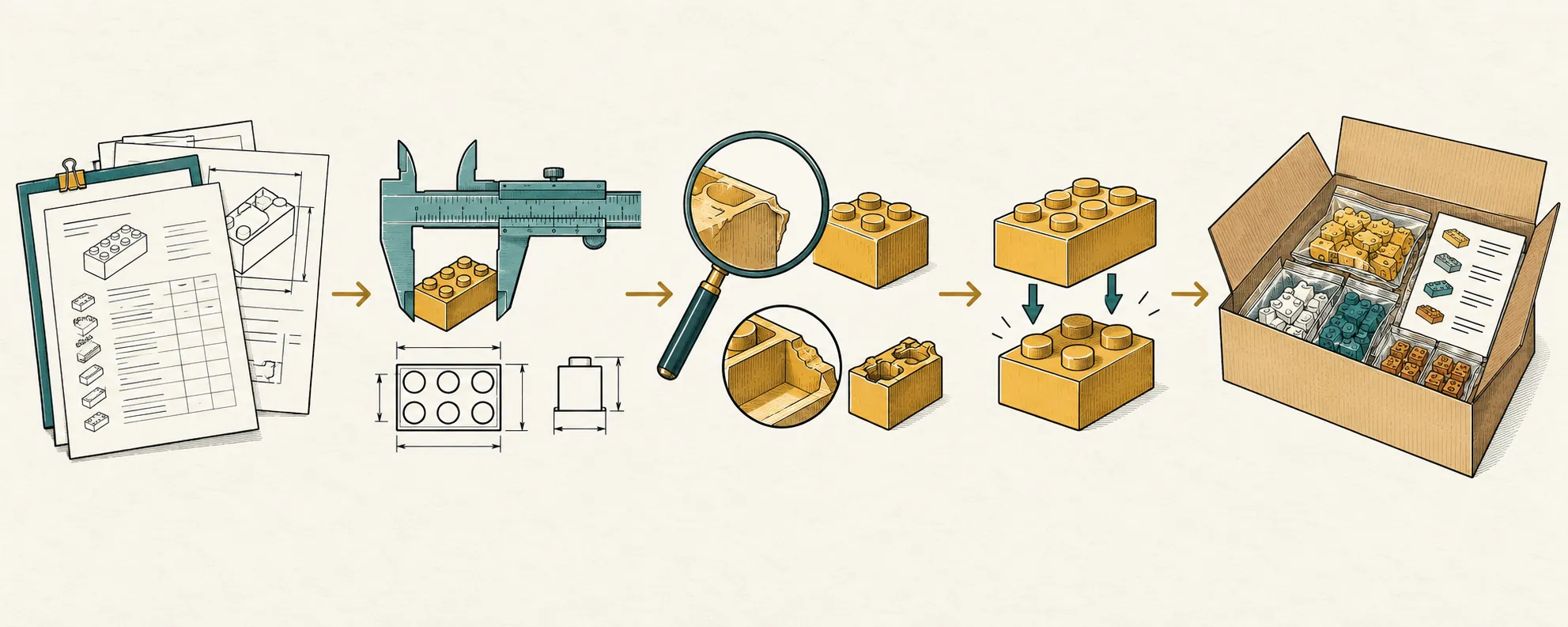
How do you reconcile the parts list against a sample kit?
Reconcile each identified component against a revision-controlled parts list; a total of 182 alone cannot establish that the kit contains the correct parts.
Request an illustrated bill of parts tied to the exact kit version. Each line should identify the component by reference or image, distinguish relevant shape and color variants, and state the required quantity per kit. Ask the supplier to identify whether marbles, connectors, spare pieces and non-construction accessories contribute to the advertised count. Record the instruction sheet and packaging separately unless the supplier's counting convention explicitly includes them.
For the physical check, open a sample linked to that same version and record each line's specified quantity, observed quantity and variance. Keep similar-looking components separate. A kit can reach the advertised total while containing too many of one part and too few of another.
Use these formulas as buyer checks, not catalog quotations: listed kit count = sum of all component quantities included under the agreed counting convention; line variance = observed quantity minus specified quantity. The listed count should reconcile to the advertised 182, and each component line should match its specified quantity.
Illustrative calculation only: if the supplier confirms that one sale unit is one complete 182-piece kit, then 10 kits represent 10 sale units containing 1,820 components in total. That calculation does not establish an MOQ, carton quantity or number of capsule fillers.
Which packing checks are needed before chain-store allocation?
Confirm the individual sale pack, carton quantity and packaging level represented by the dimensions before using the catalog figures for store allocation or handling plans.
“Package Size (cm): 50 x 35 x 20 cm” is a package field, not an assembled-product dimension. Ask whether it describes the individual kit pack, an inner pack or a shipping carton, then record the dimensions of each packaging level needed for the order. Request assembled dimensions separately if the chain plans to display a built model.
“Gross Weight per Carton (kg): 3.0 kg” is carton gross mass, not the weight of one kit. A derived average gross mass per kit would equal confirmed carton gross mass divided by confirmed kits per carton; it would still include an allocation of shipping packaging. Obtain a measured unit weight rather than presenting that average as product net weight.
For a capsule program, check the exact intended contents against the actual capsule and dispensing mechanism. This larger construction set must not be described as capsule-ready without item-specific confirmation. Checking a selected loose component would not establish compatibility of the complete kit.
What should the buyer's check record contain before order release?
| Product identity and revision | Record the 182-piece marble-run construction kit, its catalog source route, supplier item reference, quotation revision, bill-of-parts revision, instruction revision and sample identifier. |
|---|---|
| Specified target versus observation | Target: an agreed complete kit whose itemized count reconciles to 182. Enter observed quantities by component reference, alongside the specified quantities and any differences; attach photographs where identification needs clarification. |
| Sale-unit confirmation | Request written confirmation that one quoted unit contains one complete kit. Have the supplier define the units used for MOQ and price and specify the supplied individual packaging. |
| Packing confirmation | Request kits per inner pack and carton, identification of the 50 x 35 x 20 cm packaging level, measured individual-pack dimensions and weight, and confirmation of the 3.0 kg carton gross weight for the proposed configuration. |
| Assumptions and calculations | Keep any assumed complete-kit unit or calculated average in a separate calculation note, with its formula and inputs. Do not enter it as a supplier-confirmed specification. |
| Recommended decision and conditions | Proceed with the RFQ. Release the order after the component quantities reconcile and the supplier confirms the sale unit, quantity basis, price and packing configuration. Add capsule compatibility as a release condition only when that format is intended. |
| Responsible approver and date | Have the responsible buyer or quality approver enter their name, decision date and the document revisions covered by the approval. |
| Follow-up closure | For each discrepancy, assign an owner and due date, record the supplier's response or corrective revision, and enter the verifier and closure date after rechecking the affected item. |
When is the parts-list check sufficient to release the order?
Release the order when the agreed parts list, checked sample and purchase specification identify the same kit and resolve the quantities and packaging needed for the intended retail format.
If the total reaches 182 but individual lines do not match, hold approval of the contents until the difference is resolved. If the parts match but the sale unit or packing level remains ambiguous, continue the commercial confirmation rather than treating the sample as proof of those terms.
The record provides traceability for what was reviewed and approved. It does not, by itself, detect an undisclosed later change, so require proposed component or packing substitutions to be submitted for review before shipment.