
Choose toy payment milestones by the evidence that releases each installment, not by the percentage alone. A useful proposal separates order funding, sample approval, bulk inspection approval, and payment authorization, with a named approver for each. The main constraint is that every release condition must be accepted in the purchase terms before money moves. Compare the sample with the written specification first; retain the approved production reference afterward, then inspect bulk goods against the specification, that reference, and authorized changes.
For a buyer funding production in stages, propose a sample-linked installment and an inspection-linked balance. If fewer transactions matter more, keep sample approval as a production gate without making it a separate payment event. Neither arrangement guarantees quality.
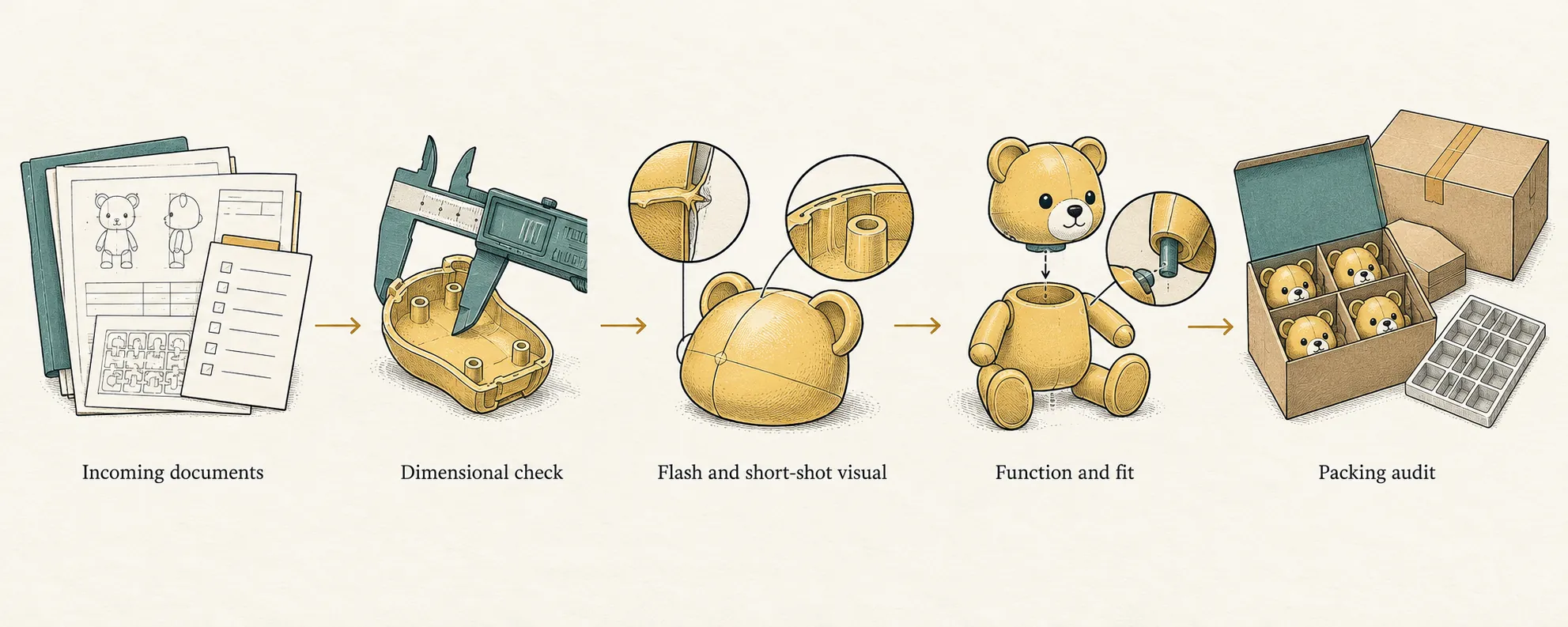
Which payment milestone structure should a toy buyer propose?
| Order deposit plus inspection-linked balance | Release the deposit against the accepted order and matching invoice. Require written sample approval before bulk production, but attach no separate installment to it. Release the balance after the buyer's quality approver accepts the bulk inspection and purchasing authorizes payment. Choose this for fewer payment events; the deposit is committed before sample acceptance. |
|---|---|
| Order deposit, sample-linked installment, inspection-linked balance | Release the middle installment only after the designated sample approver signs the sample decision for the correct specification revision. Release the balance after bulk inspection approval and closure of payment-blocking discrepancies. Choose this when the supplier needs staged funding; more money is paid before bulk consistency has been checked. |
| Staged payments with an agreed receipt holdback | Retain an expressly agreed amount until the receiving team confirms the specified arrival checks, such as delivered quantity, item identity, and visible transit condition. Purchasing authorizes the holdback release after the receiving record is accepted. Choose this when arrival discrepancies need their own payment gate; define the deadline and covered issues so the holdback does not become an open-ended dispute. |
What must first sample approval confirm before a payment is released?
First sample approval should confirm that the identified physical sample meets the agreed written specification and design requirements; only then should it become an approved production reference.
Identify the sample, specification revision, design or artwork revision, and packaging revision before reviewing it. For a chain-linked squid toy, observe the agreed movement or articulation, link alignment, and any binding or separation during the agreed handling check. Do not infer a powered function or a particular mechanism from the product name.
Compare the material declaration with the specified material and component callouts. Examine visible finish, molding residue, cracks, color, and print placement. Measure the product dimensions identified on the drawing separately from its package dimensions. Check the agreed retail contents, packaging artwork, and labels. Record actual observations rather than writing only “looks good.” Visual inspection and touch do not establish material composition.
If the sample differs from the specification, record the discrepancy and choose correction, resampling, or an explicitly authorized specification change. Do not quietly redefine the requirement to match the sample. After approval, label and retain the production reference and link it to the signed specification and change record.
A hand inspection does not establish regulatory safety or determine age suitability. Where a release condition calls for laboratory evidence, identify the applicable report and tested construction separately from the commercial sample review.
Chain-linked squid toy: recorded packing basis
| Package Size (cm) | 7.5 x 12 x 4.8 |
|---|---|
| Carton Quantity | 240 pcs/carton |
| CBM per Carton | 0.115 |
| Carton Size (cm) | 49.5 x 46.5 x 50 |
| Net Weight per Carton (kg) | 15.0 |
| Gross Weight per Carton (kg) | 16.0 |
What sale unit must the approval and invoice identify?
The approval and invoice must identify the same agreed sale unit, including what each unit contains and whether its packaging is included.
Ask directly: “Does one invoiced piece mean one toy, one retail pack, or another defined set? How many toys are in each pack, and what exactly does 240 pcs/carton count?” Confirm this in the quotation, packing specification, inspection instructions, and invoice basis. A carton quantity is not automatically an order multiple.
Keep packing measurements in their proper role. Package Size is not a verified product dimension, and Net Weight per Carton and Gross Weight per Carton are carton masses, not individual toy weights. Do not use these fields to approve capsule fit or unit weight. Confirm those separately if they affect the order.
If a commercial record contains an ambiguous Weight field or an incomplete dimension, keep its original label in the working record and obtain a defined measurement before using it as an acceptance target.
What should bulk inspection compare before the balance is released?
Bulk inspection should compare identified production goods with the current written specification, the retained approved sample, authorized changes, and the agreed inspection plan.
Record the order and lot identity, quantities presented, quantities examined, selection method, inspection stage, and report date. Use an agreed inspection plan rather than treating one attractive sample as evidence for the entire order. The retained reference complements the documents; it is not the only valid basis for review.
Repeat the relevant function, finish, dimension, and packaging checks on production goods. Match material declarations and component identities to the approved requirements, while keeping laboratory conclusions separate. Count the defined sale units and verify the packing configuration against the accepted packing specification.
Failure signals include a different packaging revision, incorrect contents per sale unit, movement that does not meet the agreed function, or measured dimensions outside the agreed acceptance limits. Record each discrepancy against its requirement and decide whether it needs rework, segregation, resampling, further inspection, or a documented concession.
A missing photograph alone does not invalidate an otherwise traceable review. Conversely, photographs alone may not establish function, measurements, or the contents of closed packs.
Worked example: sample and bulk discrepancy record
| First sample review — Sample S1, review day 1 | Target: specification B, dimensional sheet D1, and packaging artwork B. Observation: the review records movement, visible finish, and dimensions as meeting their written criteria, but the pack uses artwork A. Decision: sample approval held; do not create an approved production reference. Responsible approver/date: buyer sample approver, review day 1. Follow-up: supplier submits corrected packaging with an identified resample. |
|---|---|
| Resample closure — Sample S2, review day 3 | Target: close the artwork discrepancy without introducing another construction change. Observation: corrected artwork B and unchanged construction are recorded in the resample review. Decision: approve S2 against specification B and retain it as production reference PR1. Responsible approver/date: buyer sample approver, review day 3. Closure: signed approval links S2, PR1, sheet D1, and packaging B; the sample-linked installment becomes eligible for payment authorization. |
| Bulk inspection — Lot L1, review day 10 | Target: specification B, PR1, packaging B, the agreed sale unit, and the accepted packing configuration. Observation: an artwork A pack is found in the examined goods. Decision: hold the inspection-linked payment pending disposition; retain the other inspection observations. Responsible approver/date: buyer quality approver, review day 10. Follow-up: supplier identifies affected goods, repacks them, and submits completion evidence. |
| Bulk discrepancy closure — Lot L1, review day 12 | Target: verify the repacking scope and correct packaging revision. Observation: the agreed follow-up inspection records packaging B within its examined scope and links the supplier's rework record. Decision: buyer quality approver closes the discrepancy and approves the inspection gate. Responsible approver/date: buyer quality approver, review day 12. Follow-up: purchasing checks the invoice and milestone amount before authorizing payment. |
Worked example: payment milestone and release-condition table
| Order funding — amount D | Release evidence: accepted Example A order, specification B, defined sale unit and packing basis, accepted payment schedule, and matching invoice. Responsible approver: purchasing manager; finance executes payment after the dated authorization. Decision: release only when these commercial terms are accepted. Confirmation limit: this deposit does not establish sample acceptance or bulk quality. |
|---|---|
| Sample-linked installment — amount S | Release evidence: signed S2 approval dated review day 3, linked to specification B, sheet D1, packaging B, and retained reference PR1. Responsible technical approver: buyer sample approver; purchasing separately authorizes the invoice. Decision: S1 does not release this installment; approved S2 does. Closure condition: the artwork discrepancy is signed closed, with any unrelated confirmations still listed separately. |
| Bulk inspection-linked balance — amount R | Release evidence: Lot L1 inspection report, agreed inspection scope, packing and sale-unit checks, and signed discrepancy closure dated review day 12. Responsible technical approver: buyer quality approver; purchasing authorizes the balance after reconciling the invoice. Decision: hold at review day 10; authorize after the accepted closure. Confirmation limit: approval describes the inspected scope, not a guarantee that every unit is defect-free. |
| Exception authority | The purchasing manager may authorize only the partial release or concession permitted by the accepted terms, supported by the quality approver's written disposition. Record the affected quantity, payment amount, remaining condition, responsible owner, and closure deadline. The inspector reports findings but does not independently change the payment agreement. |
How should payment formulas and release conditions be written?
Calculate milestone amounts from the accepted commercial basis, and keep those calculations separate from inspection findings.
For the proposed three-payment structure, let V be the agreed order value covered by the schedule, D the deposit, S the sample-linked installment, and R the inspection-linked balance. The formula is R = V − D − S. Define the currency and whether V includes packaging or other charges. Account for any separate sample fee according to the accepted quotation rather than silently treating it as a credit.
If the price is quoted per sale unit, the goods-value formula is quantity of agreed sale units × quoted price per sale unit. The quantity basis must match the invoice and inspection record. The catalog packing figures above are not a price quotation and do not determine any installment.
A usable proposed release clause is: “Release the inspection-linked amount only after the designated buyer quality approver has signed acceptance for the identified order and lot against the listed specification, packaging revision, production reference, and inspection plan; all payment-blocking discrepancies must have an accepted closure or written concession. Purchasing must then approve the matching invoice and amount.”
Add the agreed review deadline and state what happens to unresolved issues: hold the affected milestone, authorize a defined partial release, or accept a documented concession. Do not use an unexplained “conditional approval” as a payment instruction. Name the condition, its owner, the evidence required to close it, and the person authorized to sign the closure.