
Approve a blind-box character series against a revision-controlled assortment and packing instruction, not a promise that the contents are “random.” Assortment control requires a defined sale unit, documented design rights, style counts, a chase replacement rule, traceable pack codes and measurable production tolerances. Before releasing the purchase order, distinguish what the factory must pack from what a consumer might receive, and record the evidence, responsible approver and conditions required to authorize production.
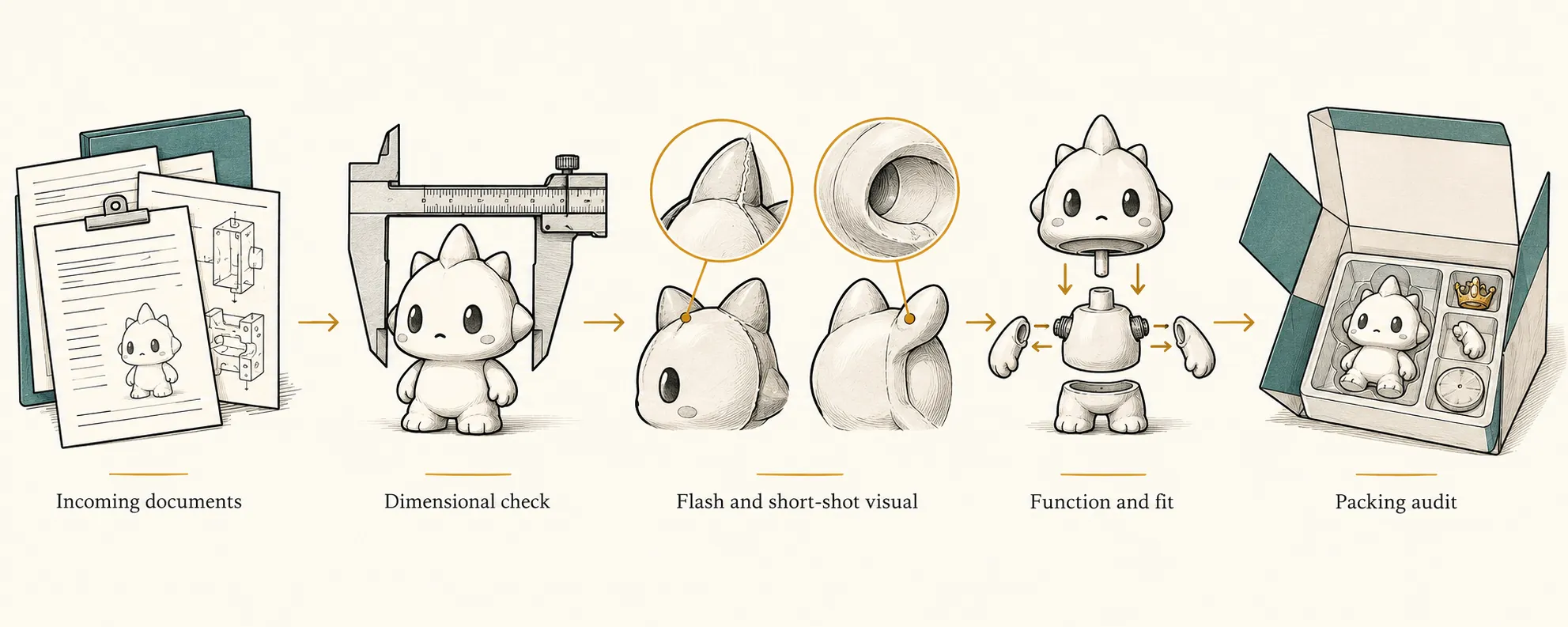
What is being sold as one unit, and what mix does it contain?
Define the consumer sale unit separately from the display, shipping carton and ratio-control block.
One sealed character box, a six-box assortment and a master carton are different approval objects. Write down how many toys each contains, whether customers can buy individual boxes, and whether the display is sold intact or broken into singles. For vending, specify whether the sale unit includes a capsule or another container; confirm its dimensions for the actual item rather than assuming fit.
Then resolve the full-set promise. “Six boxes without duplicates” does not necessarily mean “all six standard characters” if a secret replaces one standard character. If complete standard sets are the priority, choose a no-replacement configuration or separately define how the chase is supplied. If the chase replaces a standard, state that exception in both the packing instruction and the proposed sales wording.
A carton quantity establishes a recorded packing count. It does not establish style ratios, no-duplicate displays, capsule fit or the contents of a consumer set.
What do recorded catalog packing fields actually confirm?
| Packaging | Display Box |
|---|---|
| Carton Quantity | 288 pcs/carton |
| Net Weight per Carton (kg) | 18.0 |
| Gross Weight per Carton (kg) | 20.0 |
What design-rights evidence should be approved before tooling?
Require a documented rights basis covering the character artwork and the intended manufacturing and sales use before authorizing tooling.
For licensed characters, identify the rights holder, authorized contracting parties, covered designs, product category, territory, term and any required artwork approvals. For commissioned original characters, retain the relevant assignment or permission documents and identify the approved artwork revision. Include packaging illustrations and character names in the review, not just the toy sculpt.
Record the document reference, reviewer and approval date. A supplier’s copyright statement is a claim to examine, not a substitute for the underlying scope of permission. A safety test report answers a different question and does not establish design rights.
If rights review remains open, the commercial decision should say exactly what is withheld: tooling authorization, production release or both.
Should the series use equal or weighted character ratios?
| Balanced plan: before secret replacement | A–F: 12 units each. Total = 6 × 12 = 72. |
|---|---|
| Balanced plan: one illustrated carton after replacement | S replaces F: A–E = 12 each; F = 11; S = 1. Total = 60 + 11 + 1 = 72. Standard counts are not equal within this individual carton. |
| Balanced plan: equality over the control block | Rotate the displaced standard across six cartons, once for each of A–F. Each standard then totals (6 × 12) − 1 = 71. Six secrets plus 426 standards = 432 total units. |
| Balanced plan: display instruction | Twelve six-box displays per carton. Ordinary displays contain A–F once each. One display contains S instead of its scheduled standard. The replacement schedule rotates across the six-carton block. |
| Weighted alternative: before replacement | A = 18; B = 14; C = 12; D = 10; E = 10; F = 8. Total = 72. These are illustrative buyer-selected counts. |
| Weighted alternative: after replacing F | A = 18; B = 14; C = 12; D = 10; E = 10; F = 7; S = 1. Total = 72. |
| Weighted alternative: sales-unit consequence | Do not describe every six-box display as a complete, no-duplicate assortment. Twelve such displays would require 12 of each standard before replacement, which this weighted plan does not provide. |
How should pack coding and parity tolerances be specified?
Use pack codes for traceability without openly identifying the concealed character, and measure parity on the complete sealed sale unit.
Keep the factory’s style-to-pack reconciliation available for authorized inspection. External codes should identify the series, revision and production lot without an obvious consumer-readable style or chase marker. Check that character-specific barcodes, sticker colors, serial ranges or packing positions do not unintentionally disclose contents. Traceability must remain usable; concealment is not a reason to erase production records.
For the balanced example, the secret-bearing display and its position should not follow a customer-visible fixed pattern. If concealment requires position mixing, specify and record the mixing method separately from the exact count instruction. A mixed position is not proof of statistical randomness.
Set parity targets for sealed-unit mass, box dimensions, opacity and internal movement. For plush, shared body construction and controlled filling can help; other constructions require their own controls. Include accessories, cards, inserts and packaging in the mass check. Matching bare toy weights while adding a heavier secret card defeats the purpose.
As illustrative buyer screening criteria only, a specification could require a sealed-unit mass of 60 ± 2 g, outer-box dimensions of 80 × 80 × 100 mm with ±1 mm on each dimension, and a maximum difference of 1 g between sampled style-average masses. These are proposed commercial limits, not safety standards, validated limits for a catalog item or a prediction of return rates.
At pre-production review, measure five sealed samples per style, including the secret, on the same suitable scale; record individual results and style averages. Compare visible outlines, opacity, sound and movement under consistent handling. Repeat the agreed checks on production-packed samples before shipment. Passing these checks does not prove that no character can ever be identified without opening.
Illustrative blind-box series approval record
| Identity and revision | Illustrative six-character series; standards A–F and secret S. Specification and packing instruction: BB-01, revision A. Example decision date: October 28, 2026. |
|---|---|
| Sale unit and packing hierarchy | Target: one sealed box contains one toy; six boxes per display; 12 displays per master carton; 72 toys per master. Current review: hierarchy is defined in revision A. Closure: supplier packing lead signs the instruction before PO release. |
| Rights evidence | Target: rights document references covering A–F, S, names and packaging artwork for the intended use. Current status: rights authorization is an open release condition. Owner: buyer rights reviewer. Closure: attach document references, approved scope, reviewer name and approval date before tooling authorization. |
| Ratio plan and secret rule | Target: one S per 72-unit master, replacing—not adding to—one standard. Rotate the displaced standard across six masters. Review result: arithmetic reconciles to 71 of each standard plus six S across 432 units. Closure: packing lead confirms executable counts and replacement schedule before PO release. |
| Display promise | Target: no duplicates within each intact six-box display; a secret-bearing display omits its scheduled standard. Do not promise all six standards in a display containing S. Owner: buyer merchandising approver. Closure: approve matching sales wording before artwork release. |
| Pack coding and reconciliation | Target: external series/revision/lot identification; controlled internal style mapping; no overt secret marker. Observation required: approved code artwork, packed sample review and count reconciliation. Owner: supplier packing lead and buyer quality approver. Closure: sign the coding instruction before production release. |
| Parity target versus observation | Illustrative target: sealed unit 60 ± 2 g; box 80 × 80 × 100 mm, ±1 mm per dimension; sampled style-average mass spread no greater than 1 g. No physical result is asserted. Owner: buyer quality approver. Closure: attach five-sample-per-style pre-production results and approve any revised limits before production. |
| Production verification | Target: reconcile standard issues, secret issues, rejected units, rework and finished packs; inspect selected intact displays and reconcile the six-carton block. Owner: supplier quality lead, reviewed by buyer quality approver. Closure: resolve count discrepancies and document affected-pack disposition before shipment. |
| Decision and responsible approver | Illustrative decision: HOLD PO RELEASE; ratio arithmetic accepted for specification development only. Responsible approval role: buyer purchasing lead. Example decision date: October 28, 2026. Tooling and production remain unauthorized until their listed conditions are closed. |
| Follow-up closure and changes | Each condition requires an evidence reference, named closer and closure date. The purchasing approver then records the release decision and date against BB-01 revision A. Changes to styles, counts, inserts, packaging or tolerances require documented review and an identified replacement revision before use. |
| Excluded outcome claims | No claim of true statistical randomness, independent draws, a guaranteed secret within any 72 individually purchased boxes, or verified consumer odds based solely on planned packing counts. |
What can be promised about random outcomes?
Promise only the contents or packing configuration that the approved instruction and verification actually support.
In the worked example, one secret per intact 72-unit master is a proposed factory packing requirement. It does not mean that any 72 boxes bought across stores, replenishments or opened displays will include a secret. Likewise, no duplicates within one approved display does not mean no duplicates across several displays.
The planned secret share is 1 ÷ 72, approximately 1.39% of packed units. That is a composition calculation, not evidence that every purchase is an independent draw with a verified 1.39% probability. Do not turn the ratio into a guaranteed pull count.
Keep the approval boundary equally clear: a signed record supports traceability and accountability, but cannot by itself prevent an undisclosed substitution. Pair it with approved samples, packing reconciliation, appropriate inspection and documented change approval. Release the defined revision—not an assortment that can be adjusted without review.