
Approve a novelty toy assortment only when its sale unit, packing basis, variant identity and supporting documents describe the same offer. For US/EU buyers, moving from generic assortments to documented series means replacing an open-ended mix with an agreed product-and-pack record—not simply adding a series name. Before committing to volume, reconcile the quotation, specification, approved sample and draft destination packaging; establish which shipment records will confirm the final pack-out.
Choose a documented mixed assortment when controlled variation suits the program. Request changes first when the mix, individual sale unit or document coverage remains ambiguous. Decline an offer when the supplier cannot agree to the identity and substitution controls your purchasing program requires. A missing document alone does not establish supplier dishonesty or inability.
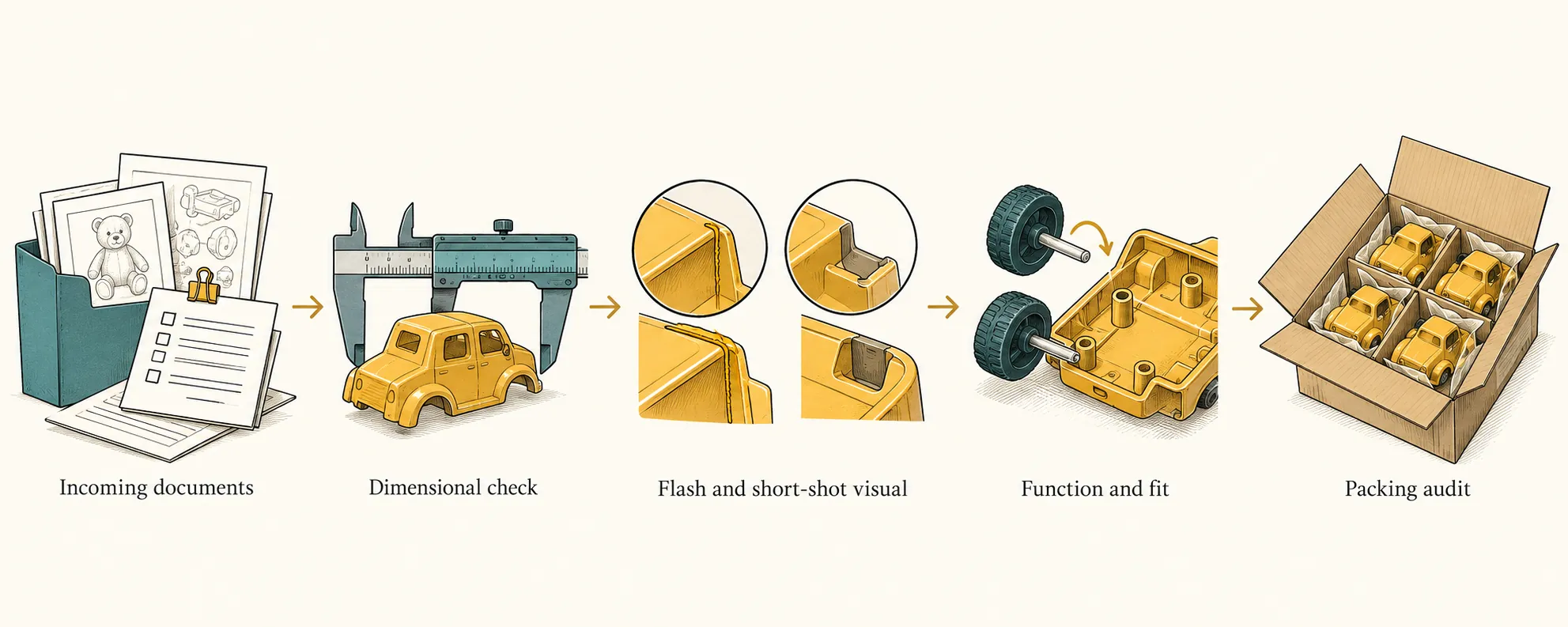
What separates a generic assortment from a documented series?
| Sale unit | Generic offer: “assorted toys” without defining what one ordered unit contains. Documented series: piece, set, display or other sale unit is defined, including its contents. Buyer consequence: quantity and price comparisons use the same denominator. |
|---|---|
| Recorded packing | Generic offer: a carton count without explaining its relationship to sale units. Documented series: sale units per inner pack and carton are reconciled with carton dimensions, volume and weights. Buyer consequence: receiving and allocation plans have an agreed basis. |
| Item-specific confirmation | Generic offer: representative photographs with unrestricted substitutions. Documented series: named variants, identifying photographs, construction details and an agreed substitution process. Buyer consequence: the buyer can distinguish an allowed variation from a changed offer. |
| Document-to-product linkage | Generic offer: a report or certificate attached without a product cross-reference. Documented series: the offered configuration is mapped to the relevant sample, reports, certificates and packaging revision. Buyer consequence: documents can be reviewed for the product actually being purchased. |
Which documents belong in the pre-PO approval file?
| Item specification and assortment schedule — before PO | Owner: supplier prepares; buyer product or merchandising lead approves. Useful fields: product reference, revision, photographs, sale-unit contents, allowed variants, allocation basis, materials by component, functions, accessories and battery details where applicable. Mismatch consequence: the proposed mix or construction is not yet a controlled purchasing specification. |
|---|---|
| Quotation and provisional packing sheet — before PO | Owner: supplier sales and packing teams; buyer purchasing reconciles. Useful fields: quotation revision, price denominator, order quantity, quoted MOQ, sale units per display or inner pack, carton quantity, dimensions, CBM, net weight and gross weight. Mismatch consequence: the buyer cannot reliably compare the offer or plan receiving quantities. |
| Sample approval record — before PO, or an explicit preproduction gate | Owner: buyer product or quality approver; supplier retains the agreed reference. Useful fields: sample identity, dated photographs, specification revision, measured observations, accepted deviations, decision, approver and date. Mismatch consequence: the physical reference and written specification need reconciliation before the affected approval is released. |
| Draft destination packaging and artwork approval — before PO | Owner: supplier packaging team prepares; buyer packaging and compliance roles review. Useful fields: destination country, sale-unit presentation, artwork revision, product identity, barcode, proposed age presentation, warnings, instructions and carton marks as applicable. Mismatch consequence: the proposed retail pack may not match the intended destination or approved product identity. |
| Test-report and certificate coverage register — before PO review, with outstanding release conditions recorded | Owner: buyer compliance lead assembles and reviews; laboratory issues its reports and the responsible certificate issuer issues the certificate. Useful fields: report or certificate reference, covered product description, sample photographs, construction, variants, applicable market, testing references and a documented product cross-reference. Mismatch consequence: coverage must be resolved; an attached document is not automatic support for every item in the assortment. |
What do actual novelty toy catalog fields establish?
| Gradient mini bun squishy steamer | Product Size: 10 x 10 x 6 cm; Carton Quantity: 288 pcs/carton; CBM per Carton: 0.201; Carton Size (cm): 63 x 62.5 x 51; Net Weight per Carton (kg): 25.0; Gross Weight per Carton (kg): 27.0. |
|---|---|
| Glitter gelatin smiling bun | Product Size: 8.5 cm; Package Size (cm): 31 x 20.5 x 11.5; Carton Quantity: 72 pcs/carton; CBM per Carton: 0.057; Carton Size (cm): 42.5 x 32.5 x 41; Net Weight per Carton (kg): 36.0; Gross Weight per Carton (kg): 37.0. |
How should sale units, dimensions and carton weights be reconciled?
Confirm what “pc” represents before treating a carton quantity as a count of individually saleable toys.
For the smiling bun, ask whether Package Size (cm): 31 x 20.5 x 11.5 describes an individual sale pack, a display or another packing level. Keep that field separate from Product Size: 8.5 cm. The single product-size measurement does not establish a complete three-dimensional envelope, and neither measurement establishes capsule or vending-machine fit.
Carton weight is not unit weight. Dividing Net Weight per Carton by Carton Quantity produces an average on the recorded carton basis, not a measured weight for each toy. Request an individual product measurement if weight matters to dispensing or handling.
Planning formula—not a supplier quotation: total nominal carton volume = confirmed carton count × confirmed CBM per Carton. Use the recorded packing basis only after the supplier confirms it. Carton quantity also does not, by itself, establish a full-carton ordering restriction.
How do buyers link reports and certificates to each variant?
Link documents through product identity and construction, not through a shared series name or a matching cover-page photograph alone.
Request a cross-reference connecting the quotation line, specification revision, approved sample, packaging version and relevant document references. For a tactile novelty toy, identify the outer body, filling or gel where present, decorative components, detachable accessories and any powered features. A broad material label should not stand in for the complete construction.
A changed color formulation, filling, accessory, battery arrangement or body construction warrants a coverage review. It does not automatically mean every variant needs a separate report. Equally, a new internal item number does not automatically invalidate existing evidence. Review tested construction, documented coverage, changes, applicable retest duties and retailer policies separately; do not impose a universal report-expiry rule.
For the US certificate review, CPSC guidance calls for identification sufficient to connect the covered product to the certificate; a laboratory report is not itself a Children’s Product Certificate. Keep that distinction visible in the approval register. CPSC CPC guidance
For an EU destination, maintain a separate destination review rather than treating the US certificate as a substitute. The commercial identity checks can be shared across markets; the applicable document route must be assessed for the destination.
A current-lot inspection can compare visible identity, workmanship and pack-out with approved requirements. It does not replace safety testing or establish that a laboratory report covers the shipped construction.
What does a completed assortment documentation check look like?
| Sale unit — Needs supplier clarification | Target: one individually packaged toy per ordered unit. Recorded observation: Carton Quantity is 72 pcs/carton, while Package Size (cm) is 31 x 20.5 x 11.5. Closure: supplier identifies what one piece and one package contain; buyer purchasing accepts the written definition. |
|---|---|
| Packing basis — Confirmed as a catalog record only | Target: an agreed order-specific packing sheet. Recorded observation: Carton Size (cm) is 42.5 x 32.5 x 41; CBM per Carton is 0.057; Net Weight per Carton (kg) is 36.0; Gross Weight per Carton (kg) is 37.0. Closure: supplier reconfirms these values for the proposed sale unit and packing revision. |
| Item-specific confirmation — Missing in this illustrative scenario | Target: agreed variant list, component construction and sample reference. Recorded observation: the scenario has no signed item specification or sample approval. Closure: supplier supplies the specification and sample; buyer product or quality approver records observations against the target and signs the accepted revision. |
| Document-to-product linkage — Missing in this illustrative scenario | Target: a reviewed cross-reference between the offered construction and supporting documents. Recorded observation: the scenario has no completed coverage register. Closure: buyer compliance records the coverage decision and any outstanding testing or certificate conditions. |
| Order decision — Hold | Do not release the PO in this scenario because the sale-unit definition and approval basis remain unresolved. Required approvers: buyer purchasing manager, with product/quality and compliance concurrence for their respective conditions. Each approver records their name and actual decision date. |
| Follow-up closure | Assign supplier responses to named contacts and buyer-agreed due dates. Attach the revised quotation, packing sheet, specification and review decisions; record who closed each condition and when. Reissue the review revision before changing Hold to Release. The record provides traceability but cannot itself detect an undisclosed substitution. |
Which final shipment records come after the PO?
| Final packing list — after packing | Owner: supplier packing or shipping team. Useful fields: PO reference, product and pack revision, actual quantities, carton identifiers or ranges, variant allocation where tracked, dimensions, net weight and gross weight. Mismatch consequence: reconcile the affected cartons and revise the release decision; do not silently overwrite the approved packing basis. |
|---|---|
| Final commercial invoice — for the actual shipment | Owner: supplier commercial team. Useful fields: PO and quotation references, product descriptions, sale-unit basis, shipped quantities, agreed prices and terms. Mismatch consequence: purchasing resolves quantity, identity or commercial differences against the order. |
| Lot inspection and shipment-release record — before dispatch | Owner: assigned inspector records observations; authorized buyer approver decides release. Useful fields: lot identity, approved specification and artwork revisions, sampled observations against targets, document references, deviations, hold/release conditions, approver/date and closure evidence. Mismatch consequence: hold the affected scope until corrected or formally dispositioned; inspection observations do not replace regulatory document review. |
Which signals should change the buying decision?
Change the buying decision when an offer becomes more precisely defined—or when its records stop agreeing—not simply because a toy is described as a new series.
Watch for explicit sale-unit contents, controlled variant schedules, identifiable packaging revisions and clear product-to-document cross-references. These are observable procurement signals. A public assortment announcement may suggest a format worth investigating, but it does not establish the supplier’s allocation, availability, document coverage or demand for your program.
A bounded public assortment example comes from Australia: the M.E. Auctions Broadmeadows catalogue lists lot 325 as “BOX OF ASSORT NEW TOYS (LOC:22)” and lots 327–328 as “CRATE OF ASSORT NEW TOYS (LOC:22)”. Source: the auctioneer’s own catalogue; jurisdiction: Australia. The filename’s date code, “260823”, is interpreted here as 26 August 2023, not as an independently verified publication date. This primary-source snapshot illustrates generic assortment descriptions: the quoted entries identify a container and lot but do not specify individual sale-unit contents, variant allocation or document coverage. They do not establish what additional information the auctioneer held, or demonstrate a subsequent market-wide shift toward documented series.
Keep a separate context log for public assortment and pack developments: issuing organization, exact source route, publication or event date and its verification basis, jurisdiction, observed change and limits. Record the actual source-check date rather than implying a fresh check from an older citation. A dated launch or pack announcement can prompt a question about a supplier’s offer; it should not count as confirmation in the order-approval file. Exclude unsourced market-growth and sales claims from the procurement decision.
Proceed when the essential identity and commercial fields agree and any later-stage conditions have responsible owners and release gates. Request packing or documentation changes when a correctable ambiguity remains. Decline when the supplier will not commit to controls essential to your channel. Keep launch schedules as buyer planning assumptions, not promised market peaks. A well-linked record supports traceability; it does not guarantee that shipped goods match the approved configuration.