
A clear dumpling with beads visible through its TPR shell and a plain white PU baozi propose different campaign experiences: a moving visual feature versus space to explore a campaign mark. Neither shape alone settles the giveaway. The decisive comparison at the Hong Kong Toys & Games Fair, January 11–14, 2027 at HKCEC, is the selected toy together with the way a recipient receives it.
This preview addresses promotional agencies and corporate campaign buyers through six catalogue references. It connects tactile and visual differences to a registration handout, welcome kit or staffed demonstration. These are proposed campaign situations, not completed customer cases, confirmed exhibits or evidence that item-specific printing has been tested.
What should a campaign buyer actually do at the 2027 fair?
Define the campaign role and the handoff pack before choosing among the six references. The physical fair runs January 11–14, 2027 at HKCEC in Wan Chai; its includes Festive & Party Items, Soft Toys & Dolls, Kidult World and World of IP Licensing, marked NEW. These categories guide discovery without assigning the catalogue examples to particular stands.
Pop & Play runs January 10–13, 2027 in the HKCEC Convention Hall, open to trade and public with a designer/IP/co-branding focus. Its overlap with the main toy fair on January 11–13 can support a design-led addition to the trip. It is not a required first stop or confirmation that a particular squishy is displayed there.
Click2Match runs January 4–21, 2027, and the .com Sourcing period spans December 11, 2026–February 10, 2027. Use the meeting brief to name a candidate's campaign role and selected pack; no one-day coverage or booth adjacency is promised.
Which three campaign situations should shape the shortlist?
Use three proposed situations: registration-desk handout, individually assembled welcome kit and staffed demonstration table. They separate immediate presentation, packed presentation and a demonstrated action, without inventing a customer event or measured handling time.
For a registration handout, compare what is visible before opening with the contents actually handed over. A clear shell can expose moving fill, whereas a closed opaque outer pack reveals its printed message first. Neither presentation proves drop resistance or that the recipient understands the action without explanation.
For a welcome kit, compare the toy-body decoration proposal with a label, sleeve or insert. The material surface, seam and complete pack determine where the message can go; an undeveloped print idea is not an approved printable area. A staffed table adds a different question: which action can the host show clearly, and how is the toy reset for the next demonstration?
Why compare the white baozi with the maltose cube first?
They provide different surface-and-pack discussions, without establishing print compatibility for either. White Mini Baozi SST350800 is listed as PU foam at 8.5 × 8.5 × 5 cm, in display-box packaging, 288 pieces per master and a catalogue minimum of 3 masters/864 pieces. Its 57 × 56.5 × 43 cm master is listed at 0.138 CBM, 14 kg net/16 kg gross.
Maltose Cube SST349391 has a 6 × 6 cm field, without a third dimension. It lists 96 pieces per master and a catalogue minimum of 10 masters/960 pieces. The master is 43.5 × 30 × 42 cm, 0.055 CBM, 27 kg net/27.5 kg gross. Those weights describe the recorded master, not a measured toy.
The plain baozi creates a proposed body-decoration discussion; the cube creates a possible sleeve or outer-pack discussion. Neither has a recorded print boundary or ink-compatibility result. The baozi does have three listed dimensions, unlike the cube; its measured printable face still cannot be derived from those overall dimensions. Keep the selected decoration sample and the recipient-ready pack together instead of calling either item inherently easier to print or denser to ship.
Which mechanism-led items change the recipient's first impression?
The clear dumpling and glitter bun make visibility part of the campaign decision. Clear Dumpling SST350816 is described as a pliable transparent TPR shell with loose crystal beads. It lists 144 pieces per master, 0.098 CBM, 21 kg net/22 kg gross and a catalogue minimum of 5 masters/720 pieces. These describe the page's offer, not observed recovery speed or a seal test.
Smiling Bun SST350080 has an 8.5 cm single-dimension record and a described glitter-gelatin interior. It lists 72 pieces per master, 0.057 CBM, 36 kg net/37 kg gross and a catalogue minimum of 5 masters/360 pieces. Its 31 × 20.5 × 11.5 cm package field does not identify an individual recipient pack merely because the toy is called a bun.
For a closed welcome kit, the message is seen before the contents; after opening, the bead or glitter feature can become part of the reveal. A window is a design option to develop, not a confirmed packaging capability for these items. The clear-dumpling page does name one toy with individual display-box packaging, but that wording does not establish the protection, finish or dimensions required for this campaign.
The smiling-bun page lists EN71, 10P, ASTM, CE, CPC and SDS strings. They do not supply the actual documents or establish which selected materials and destination are covered. Keep such labels separate from the product and pack observations; this article does not award a compliance score from a catalogue string.
Why keep the knitted ball and the pop-eye novelty apart?
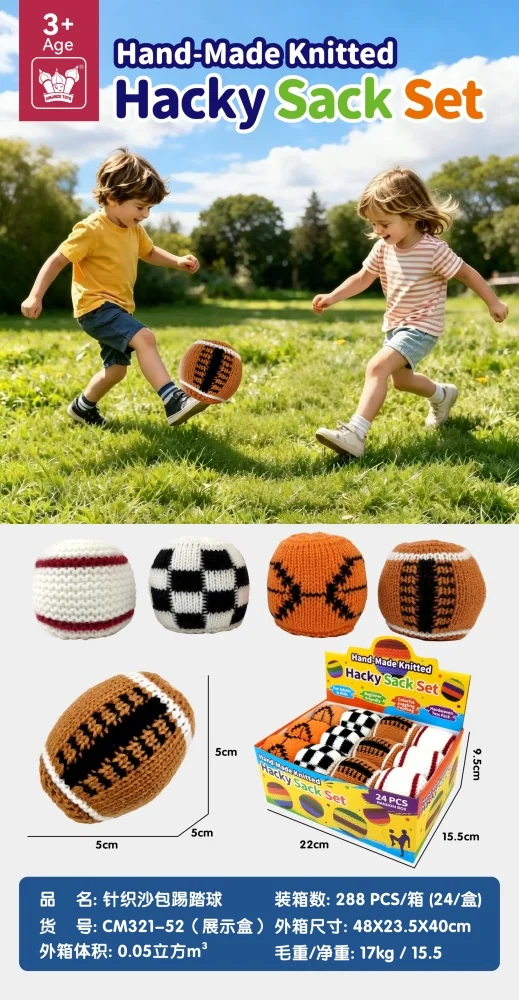
Their proposed viewing tasks differ: surface texture and fill for the knitted ball, versus the moving eye feature for the animal novelty. The source describes SST349705 as a woven exterior with sand fill and an ABS core. The associated photograph shows sports-pattern knitted forms, a 3+ supplier mark and a counter display; it does not expose the claimed inner construction.
The knitted-ball graphic labels the illustrated form 5 cm along three axes and the display 22 × 15.5 × 9.5 cm. It prints 24 PCS per display and 288 pieces per master, while the web record says 480 pieces per master and a minimum of 3 masters/1,440 pieces. Keep this quantity mismatch open. The page lists a 48 × 23.5 × 40 cm master, 0.045 CBM, 15.5 kg net/17 kg gross; none of that resolves the 288-versus-480 pack-out.
Animal Pop-Eye SST349528 records 5 × 5.5 × 7.5 without a unit in that field, 576 pieces per master, 0.164 CBM, 21.5 kg net/23 kg gross and a catalogue minimum of 1 master/576 pieces. Its page identifies eye movement and retention as sample priorities; it does not provide measured travel or a durability result.
At a staffed table, the useful record for the knitted item is the selected surface, actual weight and contained fill; for the pop-eye it is the observed squeeze, return and retained components. Keep a proposed individual pack and character mix with each reference. Neither the image's age mark nor the page's material label independently approves a recipient group.
How should the fair-meeting shortlist sheet be built?
Build one row per candidate with six fields: campaign role, actual sale unit, individual packing, proposed artwork position, labeled user group and the unresolved sample question. The table below uses the catalog records as meeting references; it is not a quotation and not a confirmed exhibit list.
Six meeting references, one campaign role each
Proposed roles below are comparison briefs. A display-pack label does not define an approved individual handoff pack; catalogue minimums are recorded entry points, not order-specific offers.
| Candidate | Proposed campaign role | Specific viewing record |
|---|---|---|
| SST350800 / White Baozi | Welcome-kit body-decoration candidate | Actual surface boundary, decoration and complete recipient pack; 288/master listed |
| SST349391 / Cube | Sleeve or message-pack candidate | Third dimension and selected packing level; 96/master listed |
| SST350816 / Clear Dumpling | Visible-fill handout or kit reveal | Selected shell/fill presentation and individual display box; 144/master listed |
| SST350080 / Glitter Bun | Glitter-led reveal or demonstration | One-dimensional 8.5 cm record versus actual pack; 72/master listed |
| SST349705 / Knitted Ball | Texture and handling at a staffed table | Web480 versus image288/master; pictured24/display; inner construction not shown |
| SST349528 / Pop-Eye | Moving-feature handout candidate | Observed eye action, retained parts and character mix; 576/master listed |
What does the pack data reveal before any price talk?
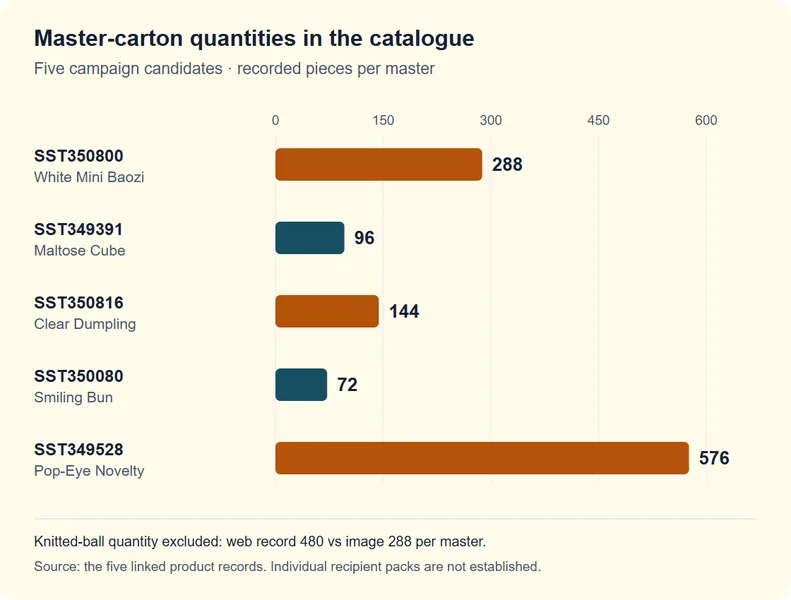
It reveals the quantity denominator and the packing level that a campaign allocation must use. SST349528 lists 576 pieces per master versus 72 for SST350080, an 8-to-1 count relationship on the recorded basis. This does not prove that either piece is individually packed or that the smaller count is a worse offer.
The chart uses five published master quantities and excludes SST349705 because its web and image quantities differ. Keep the 0.164 CBM pop-eye master and 0.057 CBM smiling-bun master with their respective pack records. Do not divide master weight into a supposedly measured unit weight or treat a package-size field as proof of recipient-ready protection.
A changed sleeve, insert or individual bag may change the carton sheet, so the campaign specification needs one defined sale unit, a recipient-pack description and its resulting master record. The price comparison can then identify toy, decoration and packing separately. Catalogue EXW references do not establish a delivered event cost.
How should a buyer tour HKCEC and arrange meetings?
Register before travelling, then use the app to turn booth visits into scheduled follow-ups. buyer registration covers personal information/SSO, company details, business-matching categories and purpose, then confirmation, and successful registration produces an email.
In the Marketplace App, Scan2Match scans exhibitor booth or product QR codes to open product details, meeting scheduling, favourites, e-floorplan and exhibitor chat. A scan does not itself confirm an appointment, so the useful habit is to scan at the booth, request a meeting in the app and note the sample question on the spot.
For arrival planning, HKCEC states Exhibition Centre MTR station, Wan Chai MTR station and Wan Chai ferry pier are within a ten-minute walk, and estimates Airport-to-Wan Chai MTR at 40 minutes and taxi at 45 minutes. Those are venue estimates, not door-to-door guarantees.
Use the January 4–21, 2027 Click2Match period to introduce the selected reference, campaign use and viewing record. The sourcing platform period of December 11, 2026–February 10, 2027 supports continuity around the visit. Actual exhibitor participation and an accepted appointment determine a route; neither the six-SKU shortlist nor Pop & Play's dates guarantees those meetings.
What should leave the fair on the shortlist?
- Retain candidates with distinct campaign roles and usable selected-version records. The proposed six roles here concern decoration, a message pack, visible fill, glitter, texture and a moving feature. Several can serve the same campaign situation; none has to be retained merely to fill every row.
- Do not rank catalog EXW references as complete giveaway costs. The catalog figures describe the item and its carton, not the individual handoff pack, the artwork position or the delivered cost. The meeting is where those become a specification.
- Move the shortlisted reference into a priced brief only with the same product version, recipient pack and quantity basis. Unresolved fields remain attached to that candidate, particularly the knitted ball's competing pack counts, so a later quotation does not silently inherit the wrong allocation.
Turn the shortlist into a priced brief
Bring the six-row sheet, the campaign role for each candidate and the sample question to the fair, then send the shortlist with quantities, artwork and destination for a comparable quotation. Squishy Toy Bulk lists the catalog items and the buying brief for that next step.