
Choose loose promotional toys for controlled kit assembly; choose individual bags when each giveaway needs its own handling barrier or marking surface. The deciding constraint is the finished handout unit—not the lowest toy-only price. Compare both formats for the same item, quantity and destination, using separate packing quotations and an approved packed sample. Confirm whether the sale unit is one toy or a complete set before comparing assembly labor, branding space, protection and shipping volume.
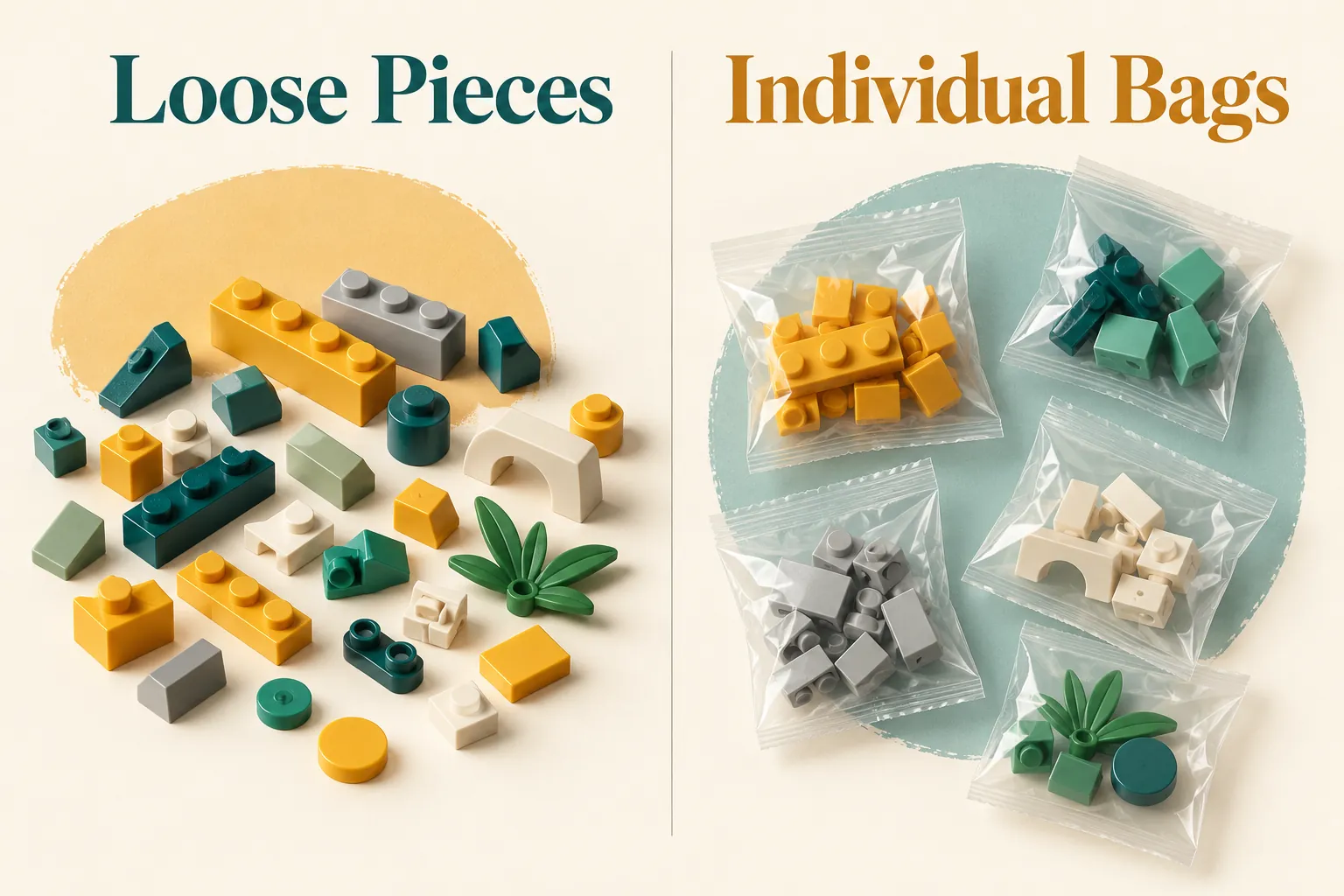
When do loose pieces make more sense than individual bags?
Choose loose pieces when your team will place the toys directly into a final promotional kit and a separate bag serves no required purpose.
Map the actual packing sequence. For loose toys, include counting, inspection, any labeling and placement into the finished kit. For bagged toys, establish whether staff will distribute them unopened or remove and discard the bags. Paying for a bag only to open it at the next workstation deserves a clear operational reason.
Choose individual bags when the bag will remain part of the finished giveaway and can carry the approved label, insert or header card. Agree on the usable artwork area on the packed sample—not merely the bag's flat dimensions. Seals, folds and the toy itself can interfere with the intended layout. Treat this as an artwork check, not proof that any particular marking requirement has been met.
How should buyers compare protection and shipping volume?
Compare the protection of the finished pack and the volume of the packed shipping carton, rather than assuming bags are cleaner or loose toys always ship smaller.
For protection, define the concern: dust during storage, direct handling during distribution, or separation of components. Inspect the proposed bag closure and the loose route's inner packing against that concern. An individual bag is not evidence of sterility or a verified contamination-control outcome; approve its practical role in the actual distribution process.
For volume, request carton quantity, outer carton dimensions, carton volume and gross weight for each proposed format. Compare equal numbers of finished giveaway units. A thin bag, a header card and a boxed pack are different configurations; do not carry one configuration's freight assumptions into another.
For capsule or vending use, evaluate the final packed shape in the actual shell and machine. The rainbow ball product record explicitly requires a shell and machine trial before it is proposed as a fill. Rainbow ball product record
What does the rainbow ball catalog actually price?
| Packaging | Color box |
|---|---|
| Wholesale price | US$0.62 / pc (EXW, tiered by quantity); indicative catalog reference for the recorded configuration |
| Package Size (cm) | 7 x 7 x 7 |
| Carton Quantity | 240 pcs/carton |
| CBM per Carton | 0.087 |
| Carton Size (cm) | 56 x 36 x 43 |
How can buyers calculate whether individual bags justify their cost?
Choose individual bags on cost grounds only when their quoted premium is offset by lower preparation or logistics costs for the same finished giveaway.
For a bounded rainbow ball comparison, request two alternatives to the recorded color box: loose toys delivered for local kit assembly, and individually bagged toys delivered ready for distribution. Keep the item, order quantity, artwork, destination and delivery scope identical. The US$0.62 EXW catalog reference belongs to the color box and must not be substituted for either alternative's price.
Use this calculation method: total route cost = quoted goods and packing + separately quoted setup + local preparation labor + comparable freight and delivery charges. Include duties and taxes on the same basis where applicable, and avoid counting packing labor twice if it is already included in the unit quote.
Calculate local preparation labor as: number of giveaway units × observed preparation seconds per unit ÷ 3,600 × loaded hourly labor cost. Time the proposed workflow with representative samples; the timing is a buyer planning input, not a published factory rate.
The break-even test is: bagged-route supplier premium ≤ avoided local preparation cost + logistics savings. Keep assumptions, measured preparation times and supplier-quoted values in separate columns on the costing sheet. If protection or marking makes a bag necessary, treat that as a purchasing requirement rather than forcing it into a savings claim.
Request printing and custom-pack minimums separately. The rainbow ball record states that its recorded MOQ applies to the source configuration, with separate minimums and setup charges to be requested for marking and packaging changes. Rainbow ball product record
Does “loose pieces” mean individual toys or components of a set?
Define the sale unit before comparing packs: an individual toy and a component of a complete activity set are not interchangeable purchasing units.
The 182-piece Marble Race Construction Kit is quoted as a complete activity set. Its product record recommends counting connectors and track sections in the packed sample for chain-store orders and agreeing on how incomplete sets will be identified. Repacking that set requires a completeness check, not just a bag price. Marble Race Construction Kit
For this set, a printed box or instruction insert can be quoted, while component marking requires separate review. The record also states that no small-capsule fit is established. Neither the component count nor a proposed bag establishes vending suitability. Marble Race Construction Kit
What should the loose-versus-bagged quotation specify?
A comparable quotation should identify the finished sale unit, both packing constructions and every operation included in each price.
Send the item reference, artwork, order volume, destination port and required arrival date when you request a documented quotation. Request separate loose and individually bagged prices, setup charges, minimums, carton quantities and dimensions, plus confirmation of what arrives ready for distribution.
Approve a packed sample against the intended workflow: count the contents, check artwork visibility, inspect the closure and verify how the unit enters the final kit or distribution channel. Select the format that meets those requirements at the lower comparable route cost—not the one with the cheaper-looking packaging line.