
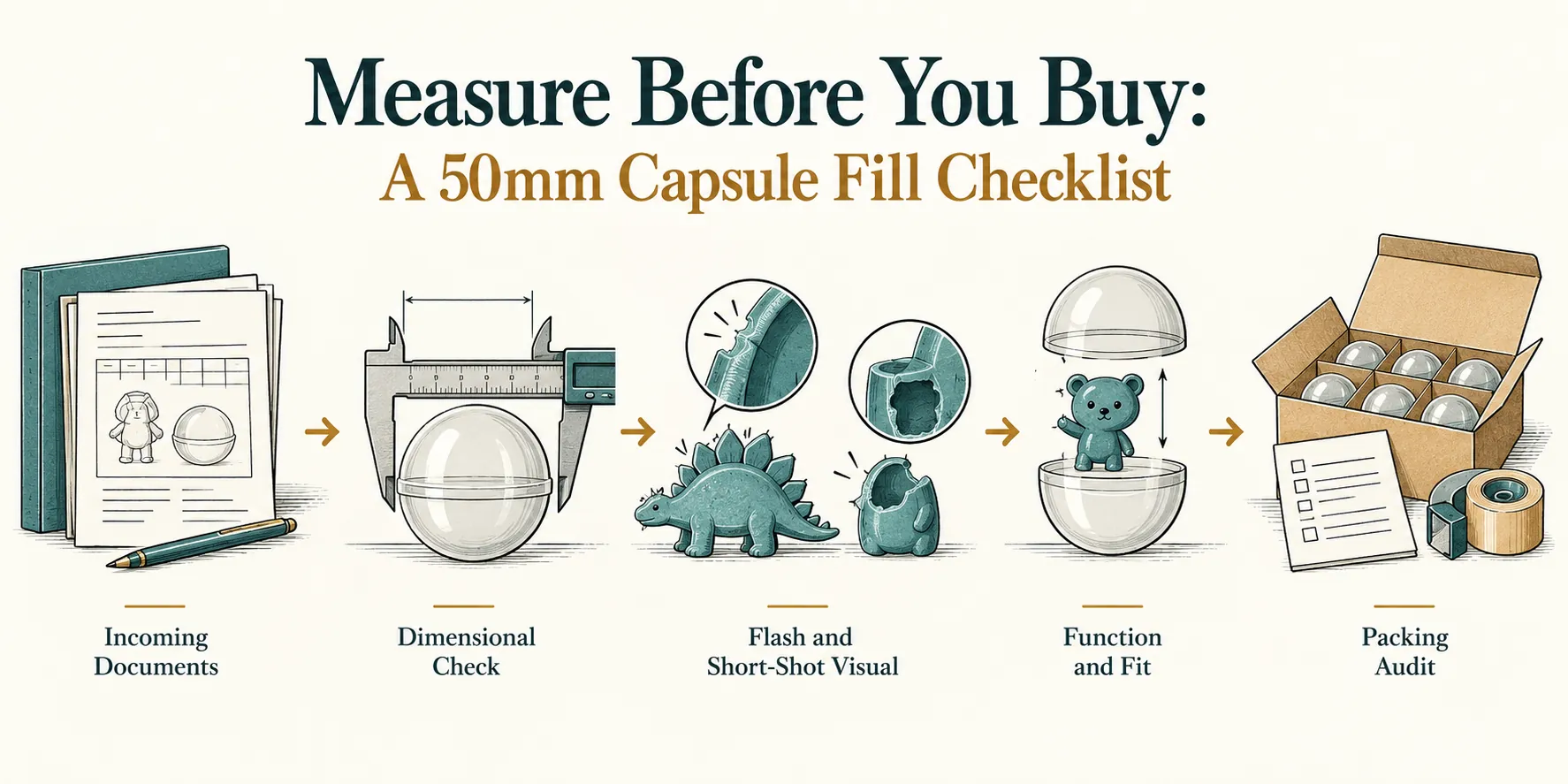
Verifying whether a toy fits inside a 50mm capsule requires checking actual usable internal space, closed seam clearances, and toy extremes in multiple orientations rather than relying solely on the nominal 50mm external diameter. Nominal size options such as 45mm, 50mm, or 65mm specified in an RFQ are simply standard designations, not proven internal volume limits. A physical sample and item-specific confirmation are necessary before issuing a purchase order to prevent assembly failures, jammed vending machines, or cracked seams.
When purchasing bulk inventory for retail distribution or capsule vending, procurement teams must look past nominal catalog descriptions. A toy that measures under 50mm on a single axis can still jam a hemisphere if rigid limbs or protruding details catch on the inner molding or the snap-shut equatorial seam.
Why Nominal 50mm Diameter Proves Nothing About Internal Fit
Relying on the headline diameter of a vending capsule guarantees sizing errors. Injection-molded plastic hemispheres feature internal reinforcing ridges, overlapping lips at the snap seam, and curved interior walls that sharply reduce the usable packing envelope. A toy with rigid extremities or awkward geometry will wedge tightly against these interior boundaries long before reaching the absolute exterior measurement.
Furthermore, different manufacturing batches can introduce minor variations in plastic wall thickness. Verifying actual usable internal space requires physical measurement of the opened capsule using digital calipers across both the polar axis and the equatorial diameter, followed by testing the item across all possible insertion orientations.
What to Measure: Essential Capsule and Toy Dimensions
| Capsule Parameter | Measurement Method & Sizing Criteria |
|---|---|
| Equatorial Seam Clearance | Measure the internal lip width where the two halves lock; protruding toy features must clear this ridge during closure. |
| Maximum Usable Depth | Measure from the apex of the inner dome to the opposing inner wall, discounting thickness variations. |
| Toy Extreme Orientations | Test item placement horizontally, vertically, and diagonally to locate maximum diagonal clearance limits. |
| Material Flexibility | Account for whether the toy compresses under light thumb pressure or maintains rigid structural boundaries. |
How to Conduct Physical Sample Confirmations
Before finalizing volume orders, request physical samples of both the empty capsules and the intended toys. Assemble the items inside the capsule manually to test whether the halves snap shut completely without bulging or leaving a micro-gap that could compromise vending mechanics.
Record packing configurations and item-specific limits carefully. If an item requires manual compression or precise angling to fit, verify whether automated or semi-automated packaging lines can handle the SKU without damaging the product or slowing throughput.
Frequently Asked Questions on Capsule Sourcing
Does a 50mm nominal capsule size mean the internal diameter is exactly 50mm?
No. 45mm, 50mm, and 65mm are nominal size descriptors used in RFQs. Wall thickness, inner locking lips, and internal curvature reduce the actual space available for the toy.
Why must toys be tested in multiple orientations?
Irregularly shaped items, articulated parts, or figures with protruding limbs often fit when laid flat in one specific direction but jam completely when dropped or loaded diagonally.
What documentation should accompany a bulk capsule order?
Buyers should request actual product specifications, packaging details, and item-specific confirmation limits from the supplier before issuing a purchase order.