
Sourcing wholesale squeezers requires evaluating distinct material profiles—primarily polyurethane foam, molded silicone, and various filled compounds—each exhibiting unique tactile feedback, rebound rates, and packing configurations. Wholesale buyers must verify catalog order fields such as Minimum Order Quantity, packaging units (such as OPP bags versus color boxes), and EXW tiered pricing before committing to purchase orders. Unidentified fills and proprietary polymer compounds must be explicitly confirmed with suppliers through item-specific documentation rather than assumed from general product categories.
When evaluating options for promotional distribution or retail assortments, buyers should examine recorded packing dimensions and unit sale configurations. Catalog data indicates significant variance: polyurethane foam squeezers often ship in high-density cartons (e.g., 2 cartons / 1080 pcs with tiered EXW pricing), whereas multi-piece silicone fidget sets in color boxes feature lower MOQ thresholds (e.g., 60 to 120 pcs) at higher per-unit price points.
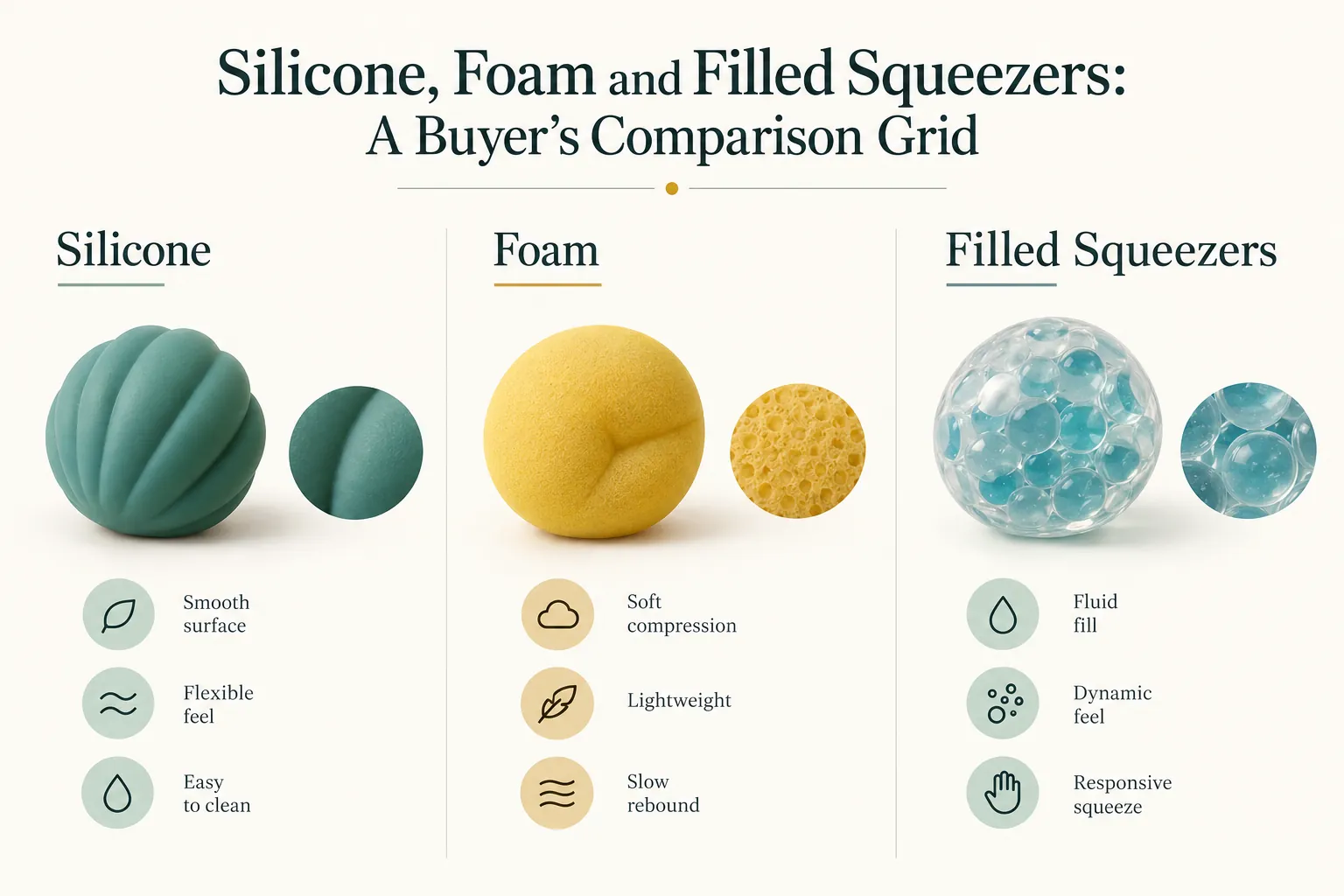
How do silicone, foam, and filled squeezers compare across catalog criteria?
| PU Polyurethane Foam (Slow-Rebound) | Material: PU Polyurethane (slow-rebound foam) | Packaging: OPP bag | MOQ: 2 cartons / 1080 pcs | Price: US$0.51-0.53 / pc (EXW, tiered) |
|---|---|
| Silicone (Single Item) | Material: Silicone | Packaging: Single item | MOQ: 432 pcs | Price: US$1.08 / pc (EXW, tiered) |
| Silicone Fidget Set (Color Box) | Material: Silicone | Packaging: Color Box | MOQ: 60 pcs | Price: US$8.95 / pc (EXW, tiered) |
| Silicone Fidget Assortment (50pcs Pack) | Material: Silicone | Packaging: Color Box | MOQ: 120 pcs | Price: US$7.65 / pc (EXW, tiered) |
What are the core material differences between foam, silicone, and filled squeezers?
Polyurethane (PU) slow-rebound foam offers a gradual, compressible tactile response well-suited for high-volume promotional distributions where low unit cost is paramount. Catalog records for slow-rebound butter and cheese styles indicate high-density bulk packing (1080 pieces across 2 cartons), requiring buyers to account for volumetric shipping weight alongside unit counts.
Molded silicone items provide greater durability and surface resilience compared to untreated foam. Single-item silicone novelties feature lower piece-count minimums (e.g., 432 pcs) while multi-piece color box assortments scale down to 60 or 120 pieces per order. Buyers must verify whether internal filling materials—when present in gel- or liquid-filled variants—are fully documented by the manufacturer to ensure compliance with target market safety standards.
How should wholesale buyers verify MOQ, packaging, and pricing terms?
Procurement specialists must evaluate unit sale configurations against actual recorded packing limits rather than relying on estimated averages. Catalog pricing operates on EXW tiered structures where unit costs decrease as order volume scales toward full carton thresholds.
When reviewing supplier documentation, buyers should request exact carton dimensions, gross weights, and individual unit packaging details (such as OPP bags versus retail-ready color boxes). Unidentified fill compounds or unlisted chemical plasticizers must be clarified prior to issuing purchase orders to prevent customs clearance delays or non-compliance issues.
Frequently Asked Procurement Questions
Are catalog MOQ requirements strictly tied to carton multiples?
Catalog minimums reflect established supplier thresholds—such as 2 cartons / 1080 pcs for foam items or 60 to 432 pcs for silicone variants—but buyers should confirm whether fractional carton orders are accepted or if full-carton rounding applies.
How do packaging choices impact wholesale shipping calculations?
OPP bag packaging minimizes volumetric weight and maximizes unit density per master carton, whereas color box packaging increases dimensional weight and per-unit freight costs while offering retail-ready presentation.
What documentation is required for filled or compound squeezers?
Buyers should request specific material safety data and test reports covering the exterior shell and internal filling compound to verify compliance with applicable regional safety regulations.