
Put a batch-by-batch release schedule in the purchase order, not just a note saying “split shipments required.” For a toy campaign, each batch needs a defined sale unit, quantity, destination allocation, approved sample revision, booking owner, and storage release conditions. The main constraint is that stock readiness, freight booking, and permission to dispatch are separate decisions. Attach the allocation schedule, sample approval reference, packing confirmation, and supplier acknowledgment so each release has a clear basis.
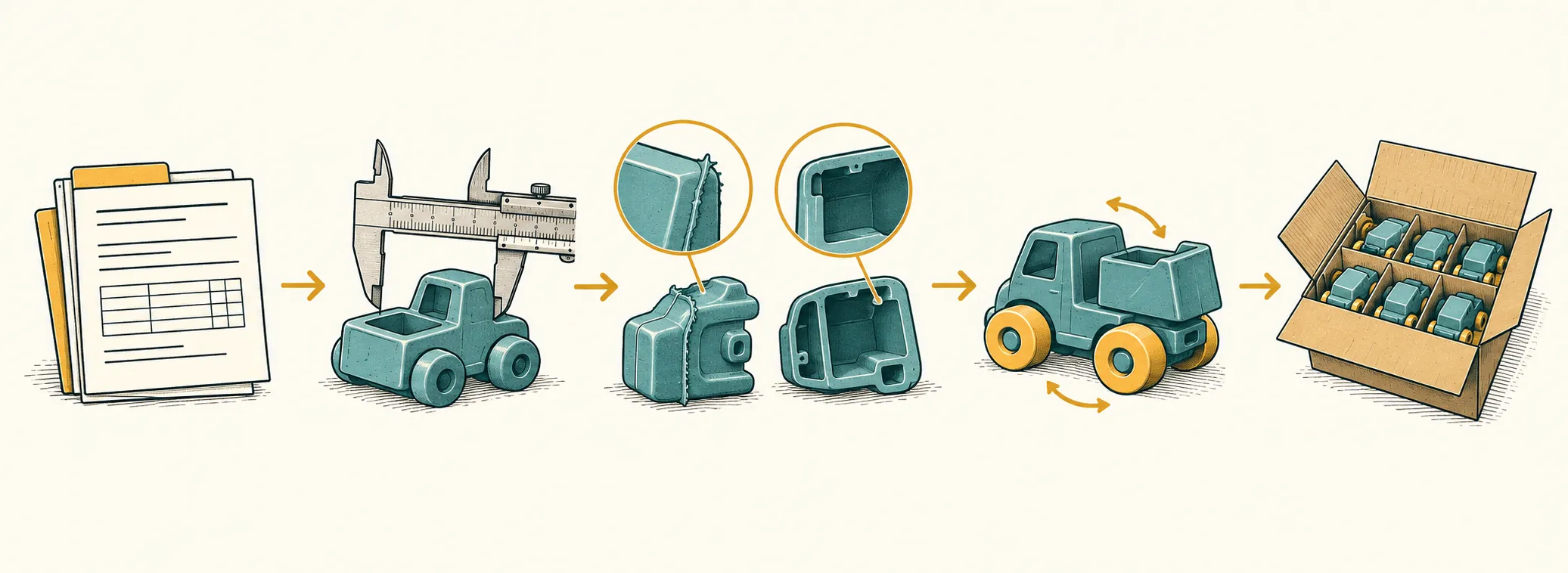
What should the split-shipment PO schedule contain?
| PO and attachment identity | Record the PO number, PO revision, campaign reference, buyer and supplier legal entities, attachment revision, issue date, and named contacts authorized to approve changes. |
|---|---|
| Order line and sale unit | Identify the toy, variant or assortment, and exact commercial unit: individual toy, complete set, or another agreed unit. State the contents of that unit and the total ordered quantity. |
| Batch quantity | Give each release batch a unique ID and quantity in the agreed sale unit. Keep production-lot references separate from shipment batch IDs and record the relationship when available. |
| Destination allocation | For each batch, list allocation ID, quantity, consignee, full ship-to address, receiving contact, and any warehouse or store reference. Allocation quantities must reconcile to the batch quantity. |
| Timing | Separate required in-hands date, receiving appointment or window, planned dispatch date, booking deadline, and storage release deadline. Identify which dates are buyer requests and which the supplier and logistics party have accepted. |
| Sample and packing references | Assign the approved product sample revision and packaging artwork or packing-specification revision to each batch. Record inner-pack and carton quantities, assortment, carton marks, and treatment of partial cartons as agreed. |
| Booking and delivery basis | Name the booking party, freight payer, carrier or forwarder contact, and agreed delivery term with its named place and edition where applicable. State who supplies shipment data and who confirms the booking. |
| Storage and release | Identify the agreed storage location, holding period, release conditions, authorizing person, notice method, and release acknowledgment. Agree storage and handling charges and what happens when a release deadline is missed. |
| Split-related charges and invoicing | State whether packing, handling, storage, and freight charges are included or separately approved. Define the invoicing and payment milestone for each batch without assuming that split delivery automatically changes the original payment terms. |
| Changes and exceptions | Require written approval for changes to quantities, destinations, revisions, packing, dispatch dates, or charges. Record the affected lines, decision, approver, date, and updated attachment revision. |
Which sample revision governs each batch?
Assign an approved sample revision to every batch, and do not let a later approval silently replace the reference for stock already produced or held.
The sample reference should identify the physical retained sample or controlled sample record, approval date, approver, product specification, and relevant packaging artwork. Ask the supplier to acknowledge the applicable revision for each batch in writing.
Recommended PO wording: “Each batch shall follow the sample and packing revisions assigned in the release schedule. Proposed substitutions or changes require written buyer approval identifying the affected batches. Approval of a new revision does not amend other batches unless the revised schedule expressly identifies them.”
Sample approval establishes the target; it does not establish that later production matches it. Keep the batch inspection or verification record separate, showing the specified target, observed result, evidence reference, and acceptance decision. If a deviation is accepted, record its scope rather than describing the batch as an exact match.
Who books each shipment and authorizes storage release?
Name a booking owner for every destination consignment and a separate person authorized to release held stock. Freight responsibility alone is not an instruction to dispatch.
For buyer-booked freight, require the supplier to provide the agreed shipment data by the booking deadline: collection address, cargo-ready status, package count, packed dimensions, weights, and shipping documents. For supplier-booked freight, specify the service or routing approval process, cost authorization, and deadline for returning the booking confirmation. Do not treat a requested delivery date as a confirmed transport plan.
Choose a fixed-date release when quantities, addresses, and receiving arrangements are settled. Choose written call-off when campaign allocations may still change. For held stock, use a not-before date together with written authorization if dispatch must satisfy both conditions.
Recommended PO wording: “Dispatch is permitted only after all release conditions listed for the batch are met and the named buyer release authority issues written authorization identifying the batch, quantity, destination allocation, and applicable revisions. A booking confirmation or cargo-ready notice alone is not release authorization.”
Agree the storage arrangement before relying on it. Specify the location, holding period, stock identification and segregation, handling charges, inventory reporting, and responsibility for loss or damage. At the final release deadline, require escalation to the named buyer contact; define any extension, transfer, or other disposition by agreement rather than allowing an automatic shipment to an outdated address.
How should the PO distinguish sale units from recorded packing?
Define what one ordered unit contains before allocating quantities; a catalog packaging description is not a complete commercial-unit definition.
For example, a magnetic building-block set is cataloged with “Packaging”: “Single item” and “MOQ”: “40 pcs.” These are catalog entries to reconfirm before the PO, not a definition of how many blocks constitute one purchased unit or how the units will be packed for split dispatch. Magnetic building-block catalog record
Request a direct confirmation: “One PO unit means one complete set containing the agreed component count, packed in the approved retail packaging.” Then specify the agreed sets per inner pack and per shipping carton, assortment rules, destination marks, and whether partial cartons are accepted. A minimum order quantity is not automatically a per-release minimum, an order multiple, or a full-carton restriction.
Keep item-specific checks attached to the relevant line. A capsule or vending order needs confirmation against the buyer’s actual capsule or dispensing specification; the phrase “Single item” does not establish fit. Likewise, request dimensions and weights for the actual packed shipment. Recorded net or gross weight per carton is carton mass, not verified individual-toy weight.
How does a batch schedule differ from a destination allocation?
A batch schedule controls when stock becomes eligible for release; destination allocations control where that stock goes. Keeping both levels prevents a timing change from unintentionally changing the destination quantities.
Hypothetical allocation example—not a supplier quote or an actual order: assume a campaign orders 1,000 complete toy sets, with one complete set defined as the PO sale unit. Batch A contains 600 sets for the launch release. Its destination allocations are 400 sets to Distribution Center North and 200 sets to Distribution Center South. Batch B contains 400 sets held for a later release to Distribution Center South.
Allocation formulas: total order = 600 + 400 = 1,000 sets. Batch A allocations = 400 + 200 = 600 sets. Batch B allocation = 400 sets. Destination totals are North = 400 sets and South = 200 + 400 = 600 sets. These calculations reconcile sale units only; they do not establish carton counts or order multiples.
In this example, assign Sample Revision A to both batches. If the buyer later approves Revision B only for the held batch, amend Batch B explicitly and obtain supplier acknowledgment of how that change will be implemented. Do not simply replace the sample attachment and assume held goods have changed with it.
Choose buyer-booked freight for this hypothetical schedule and assign the buyer’s logistics coordinator to each destination consignment. Batch A uses an agreed fixed dispatch date entered in the schedule. Batch B requires both its not-before date and written release from the campaign buyer after the South receiving appointment is confirmed. The actual dates, addresses, and named contacts must be completed before this becomes an issued PO.
If South’s first allocation moves to a later date, amend that allocation and its timing explicitly. Leaving the instruction as “delay South” would not say whether the change affects the 200 launch sets, the 400 held sets, or both.
What confirmation record should accompany each release?
| Record identity | Enter PO and attachment revision, order line, batch and allocation IDs, applicable sample and packing revisions, and the record date. |
|---|---|
| Specified target | Record the agreed sale-unit definition, batch and destination quantities, packing requirements, requested timing, booking owner, and release conditions. |
| Supplier confirmation and observations | Record the supplier acknowledgment reference and date, plus actual quantity, packing, revision, cargo-ready status, and booking details as each is confirmed. Keep statements of readiness distinct from inspection observations. |
| Decision and conditions | Record hold, release, or conditional acceptance, identifying the exact quantity and destination covered. State any unresolved condition and whether it blocks dispatch. |
| Responsible approver | Enter the authorized approver’s name, role, decision date, and written authorization reference. Identify the supplier contact acknowledging the decision. |
| Follow-up and closure | Assign each open action an owner and due date. Record closure evidence, closure date, and the person accepting closure; issue a revised schedule when the agreed instructions change. |
| Dispatch and balance reconciliation | Link the packing list and transport reference to the released allocations. Record dispatched quantity and remaining held balance, and resolve any difference against the PO total. |