
Choose a standard-shape promotional squeezer when the logo carries the message; commission custom tooling when the three-dimensional shape itself is essential and confirmed program volume justifies the added development cost. Request a modified-stock option when only part of the existing geometry needs changing. The main constraint is not uniqueness but the scope you must fund and approve. Compare three separate quotes with defined tooling rights, sample stages, order minimums and packing—not three headline unit prices.
Treat an existing catalog shape as a starting specification, not proof of available inventory or a commitment to a custom version.
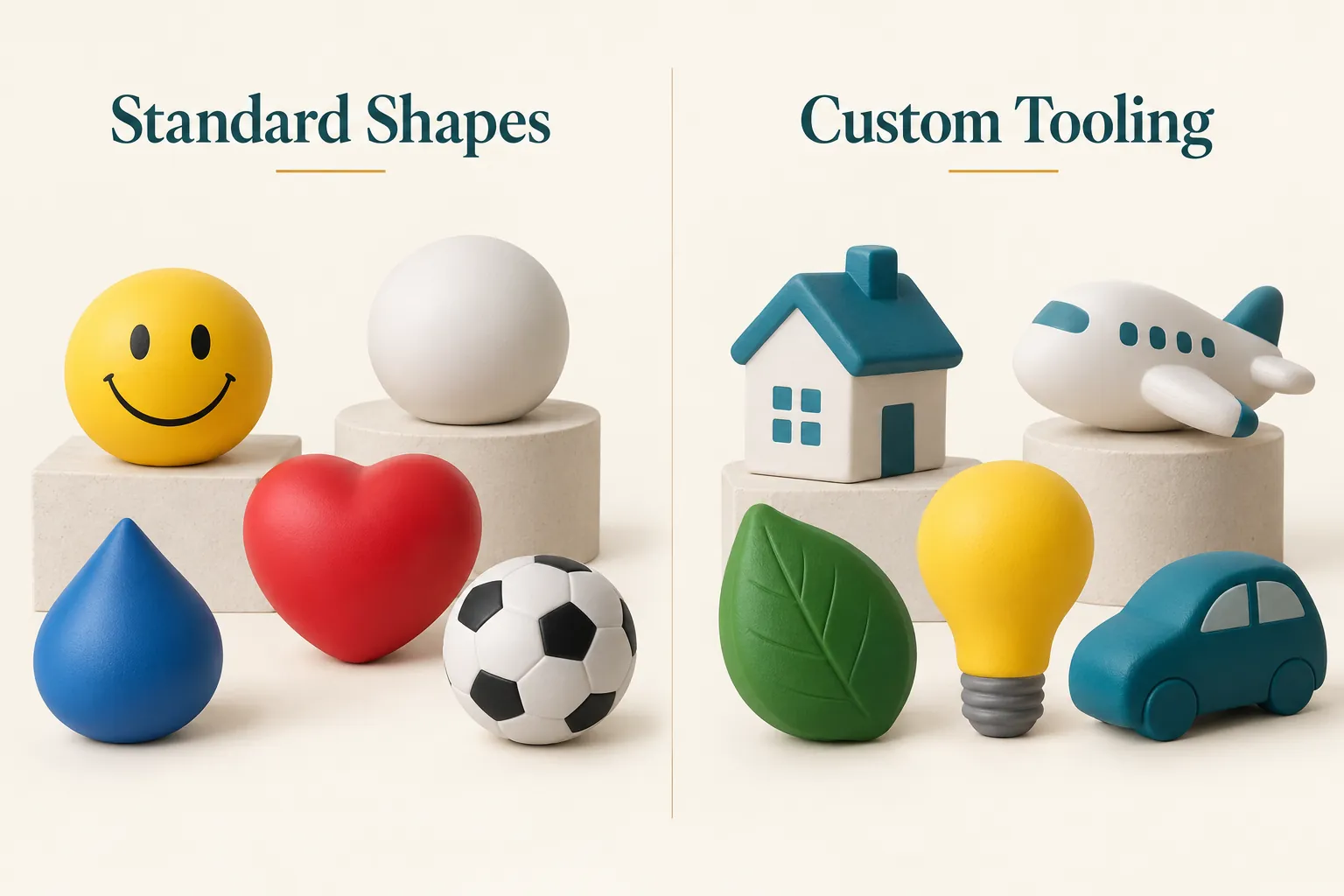
Which sourcing route matches the promotional brief?
| Standard shape with new decoration | Scope: an existing shape with a new color and imprint. Choose this route when the existing silhouette is acceptable and branding can be carried by the decoration. |
|---|---|
| Modified stock shape | Scope: an existing concept with physical changes. Choose this route when identifiable changes to an existing design satisfy the brief; request a separate description and price for those changes. |
| Fully custom tooling | Scope: an entirely new three-dimensional shape. Choose this route when the required silhouette cannot be delivered through decoration or an acceptable modification. |
Flatbed tow truck squeezer: a standard-shape reference
| Unit price — quantity tiers | 150 units: US$4.95 each; 250: US$4.85; 500: US$4.54; 1,000: US$4.12; 2,500: US$3.95. |
|---|---|
| Setup Charge | US$45.00. This is a listed setup charge, not a mold or tooling price. |
| Price Includes | 1 color; 1 location. |
| Decoration Method | Pad Printing. |
| Imprint Area | 1 inch W × 0.75 inch H on bed. |
| Second Imprint Area | 1.25 inches W × 0.125 inch H on side. |
| Units per carton | 150. |
| Carton size (L × W × H) | 18 × 15 × 13 inches. |
How should tooling and setup costs be compared?
Compare each route at the same confirmed quantity and cost boundary, separating one-time charges from recurring unit costs.
Worked calculation using published values—not a supplier quotation: the tow truck listing shows US$4.12 per unit at 1,000 units and a US$45 setup charge. Assuming one setup charge applies and the listed one-color, one-location decoration meets the brief, the goods-plus-setup subtotal is (1,000 × US$4.12) + US$45 = US$4,165. That is US$4.165 per ordered unit before taxes, shipping and handling. This calculation is neither a landed price nor a custom-tooling estimate. Flatbed tow truck listing
For the route comparison, define K as separately charged one-time development, tooling and setup costs; V as the recurring price per sale unit on an identical cost basis; and Q as confirmed program units. Under the explicit assumption that all Q units are accepted, the comparison cost per unit is V + K ÷ Q. If tooling is already embedded in V, do not add it again to K.
The incremental custom premium is (Kcustom − Kstandard) ÷ Q + (Vcustom − Vstandard). Use quoted inputs to decide whether that premium is justified by the required shape. Custom tooling does not have to become cheaper than stock to be a rational purchase—but the premium should buy a specific design requirement.
For the purchase budget, calculate landed unit cost as goods + tooling/setup + decoration + packing + inspection + origin transport + freight + insurance + destination handling + applicable duties/taxes + inland delivery, divided by accepted sale units. Count each charge once, use the same destination and delivery basis, and do not assume taxes are recoverable.
Base amortization on confirmed, repeatable programs rather than an uncommitted rollout. Request separate minimums for each route, each color or decoration variant, and repeat orders; also ask whether tooling is charged once, per order or through the unit price. Custom-Shaped Stress Toys
Which tooling and artwork rights belong in the quote?
Put tooling ownership, storage location, retention period and future access in the written quote before authorizing development.
For a standard shape, do not assume that purchasing branded units grants exclusivity over the underlying shape. For a modification, identify which existing design elements remain available to others and what, if anything, is exclusive to your program. For fully custom work, request terms covering the physical tool, editable design files and any agreed restriction on third-party use.
Ask who pays for maintenance, repair, replacement, transfer and storage; what happens after an inactive period; and whether disposal requires advance notice. Paying a charge labeled “tooling” is not a substitute for agreeing on these terms.
Confirm authorization to use licensed artwork or third-party characters before modeling begins. The sourcing guidance specifically identifies ownership, storage, retention and merchandise-rights clearance as pre-development questions. Custom-Shaped Stress Toys
What samples should be approved before production?
Approve decoration on the standard route and add geometry approval before production tooling for modified or fully custom shapes.
For standard shapes, request an undecorated reference and artwork proof; specify a decorated physical sample if placement, small lettering or color appearance is consequential. The tow truck listing states that production timing starts after proof approval, so an artwork release is a scheduling gate—not merely an administrative step. Flatbed tow truck listing
For modified stock, mark every physical change on a revision-controlled drawing and request a representative prototype before authorizing the relevant tooling work. For a fully custom shape, propose approval gates for the three-dimensional model or prototype, then a decorated pre-production sample from the intended production process. Ask the supplier to identify any prototype material or process that differs from production.
Use this approval record at each applicable gate: program and route; supplier reference; drawing/artwork revision; sample identifier and date; specified target versus observed result; approve, reject or conditional decision; responsible approver and approval date; required correction, owner and due date; and closure evidence with final release date.
Retain the approved reference sample. Compare shape, imprint position, color appearance and agreed squeeze/recovery characteristics against it as commercial checks. Keep market-specific safety evaluation separate. An approval record supports traceability; it does not by itself prevent an undisclosed production change.
What sale unit and packing must be confirmed for each route?
Confirm the priced sale unit and shipment packing separately for every route; a standard item's carton specification does not establish packing for a new shape.
The tow truck example is priced per unit and records 150 units per carton in an 18 × 15 × 13 inch carton. That carton quantity does not establish a full-carton ordering restriction, and the first published price tier does not by itself establish the order minimum.
Request the actual sale unit—each, set or carton—plus contents per sale unit, individual packaging, units per carton, external carton dimensions and measured gross carton weight. Carton dimensions are not product dimensions, and gross carton weight is not individual product weight. For capsule or vending distribution, approve the finished item in the intended capsule or mechanism rather than inferring fit from its name.
The seller states that the reference tow truck is not intended for children or pets and may present a choking hazard to children under three. Use it as an adult promotional pricing reference, not as approval for a children's toy program. For any selected route, identify the intended users and destination markets and request evidence covering the finished construction, materials, coatings and decoration. Flatbed tow truck listing
What RFQ can buyers send for a fair three-route comparison?
Send one brief requesting three separately priced routes, with the same quantity, decoration requirement, destination and acceptance basis.
Scope and price: “Quote A: existing shape with decoration; B: existing concept with the attached physical changes; C: entirely new three-dimensional shape. Identify the proposed base item or drawing revision. Separate modeling, prototypes, tooling, decoration setup, unit price, packing and other charges. State currency, delivery basis, exclusions and quote validity.”
Quantity and reuse: “State the minimum order for each route, color and decoration variant, any order-multiple restriction, and repeat-order minimums. Identify one-time versus repeat charges and any tooling amount embedded in unit prices. Base the offer on the confirmed quantity stated in this RFQ; price optional future volume separately.”
Rights and approvals: “State tool ownership, storage location, retention period, maintenance and transfer terms, disposal notice and agreed exclusivity. Identify required artwork authorization. Propose sample gates, revision identifiers, approval dependencies and timing from each approved gate.”
Sale unit and evidence: “Confirm the priced sale unit, contents, individual packaging, units per carton, external carton dimensions and gross carton weight for each route. Submit item-specific sample details and relevant market-specific test or assessment documentation, identifying the construction and decoration covered.”
Award basis: choose standard decoration if it satisfies the brief; choose modified stock if the documented physical changes deliver the required shape at an acceptable total cost; release fully custom tooling only after the geometry, commercial terms, rights and approval gates are agreed. Do not award a new mold merely because the quotation calls the product “custom.”