
A no-minimum stress ball search is not enough to approve an order: the quote must separate blank-stock, print-run, color and packaging minimums. An offer for undecorated stock does not establish the terms for a printed, color-split or custom-packed order. Before comparing prices, request those four minimums, the setup charge and its allocation, and the exact sale unit and packing for the selected item. Accept the quote only when those terms cover the order you actually intend to place.
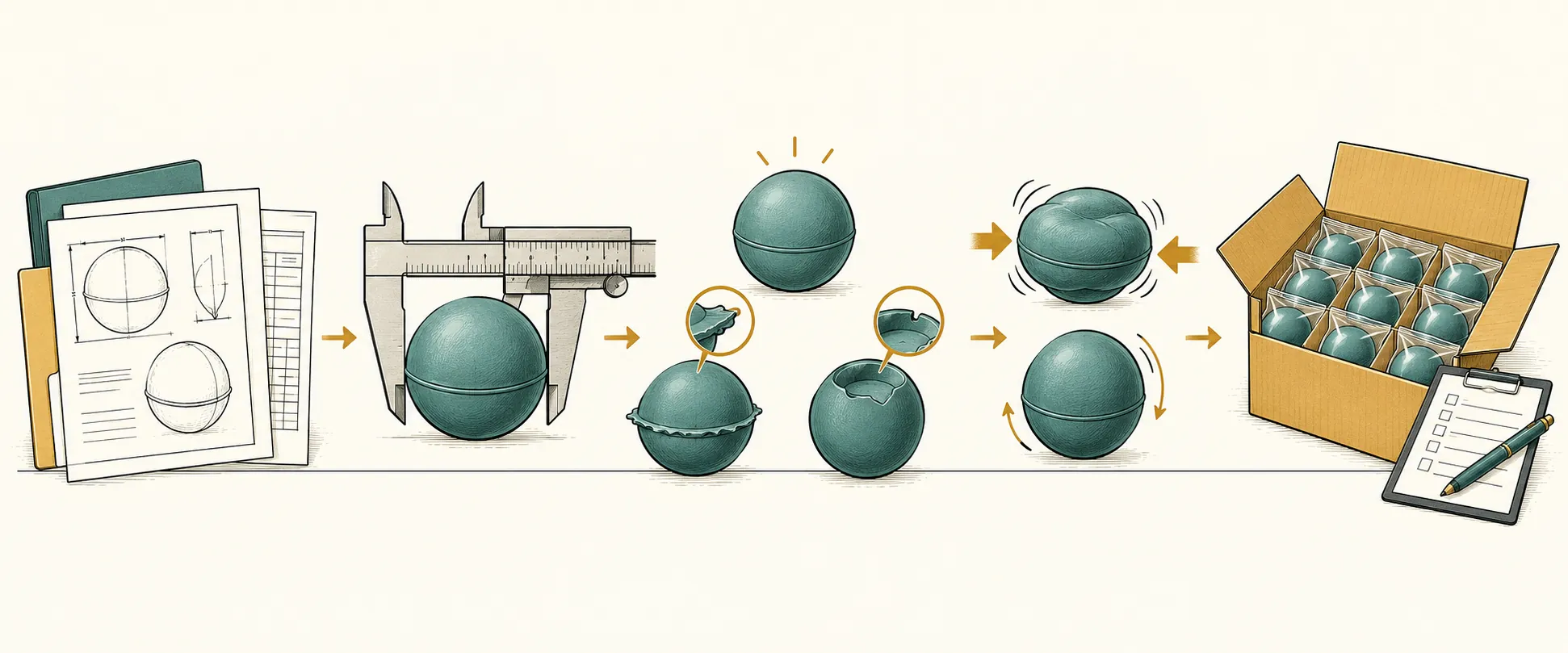
Which four minimums must a stress-ball quote separate?
A usable stress-ball quote distinguishes the minimum for buying the product from the minimums for decorating, splitting colors and packaging it. One MOQ figure should not stand in for all four.
Blank-stock MOQ is the minimum purchase of the undecorated item. Ask whether it applies to each product, each stock color or an allowed assortment. A blank-stock offer does not establish that the same quantity can be printed.
Print-run minimum is the minimum quantity accepted for a defined decoration run. Specify the artwork, printing method and print locations so the supplier can state whether different designs or versions count as separate runs.
Color minimum needs an explicit definition. A minimum per stress-ball body color is different from a requirement associated with an ink color. Request the quantity required for each body color, whether colors can be combined toward the print-run minimum, and any setup charges associated with the chosen ink colors.
Packaging minimum is the minimum for a particular packaging configuration, such as a custom-printed box or sleeve. Separate that production minimum from the number of toys packed in a shipping carton. They answer different questions.
What do actual catalog MOQ and packaging labels tell you?
| Ice-cube squeeze stress ball | MOQ: 108 pcs. Packaging: Single item. Wholesale price: US$1.06 / pc (EXW, tiered by quantity). Source: [[link:https://www.squishytoybulk.com/products/7-5cm-ice-cube-squeeze-stress-ball-slow-rebound-square-squishy-fidget-toy-for-anxiety-relief-sensory-toy-for-kids-party-favors/|Ice-cube stress ball]]. |
|---|---|
| Glitter squishy figure stress ball | MOQ: 432 pcs. Packaging: Single item. Wholesale price: US$0.56 / pc (EXW, tiered by quantity). Source: [[link:https://www.squishytoybulk.com/products/glitter-squishy-doll-stress-ball-soft-squeeze-toy-cute-mini-fidget-figure-for-kids-and-adults/|Glitter stress ball]]. |
| 12-hole rainbow stress-relief fidget | MOQ: 1 cartons / 240 pcs. Packaging: Color box. Wholesale price: US$0.62 / pc (EXW, tiered by quantity). Source: [[link:https://www.squishytoybulk.com/products/12-hole-rainbow-stress-relief/|12-hole rainbow fidget]]. |
How should you interpret the sale unit and recorded packing?
Confirm the invoice unit, the contents of that unit and the shipping pack separately; a packaging description does not establish all three.
For the ice-cube and glitter examples, “Packaging: Single item” should not be expanded into a promise about an individual bag, retail-ready presentation or master-carton quantity. Likewise, a price expressed per piece is a pricing basis; have the quote state whether the order is sold by individual piece, set or carton.
The rainbow fidget’s “MOQ: 1 cartons / 240 pcs” combines a carton reference and a piece count. Have the supplier confirm the minimum purchase, pieces per carton and whether later quantities must follow a full-carton order multiple. A carton quantity alone does not establish an order multiple or justify rounding up every order.
Record inner-pack and master-carton quantities for the exact configuration being quoted. Custom packaging can change the packing arrangement, so do not carry a standard-pack assumption into a custom-packed quote.
How do setup charges change the price comparison?
Compare the total charge at the same order quantity, not just the displayed unit price. Allocating a fixed setup charge across more units reduces its per-unit contribution, but it does not remove a print-run minimum.
Use Q for the number of pieces in the relevant print run and S for the total fixed setup charges assigned to that run. Setup allocation per piece = S ÷ Q. If the quoted unit price excludes setup, the setup-inclusive price per piece = quoted unit price + S ÷ Q. Keep separately billed packaging or other charges visible rather than silently folding them into this calculation.
Illustrative comparison—not a supplier quote: assume Offer A charges p per piece plus a separate setup charge S, while Offer B charges r per piece with all setup included. Both offers cover the same item, artwork, body-color split, packaging and quantity Q, and Q satisfies every applicable minimum. Their comparable totals are A = Q × p + S and B = Q × r.
Offer A is cheaper only when Q × p + S is less than Q × r. If p is lower than r, the saving on the pieces must exceed the separate setup charge. A lower displayed piece price is therefore not enough to select A.
Ask whether setup is charged per artwork, ink color, print location or run, and whether it is already included in the piece price. Do not add an included charge twice or assume a repeat order is setup-free.
Which questions belong in the side-by-side quote comparison?
| Blank-stock minimum | What is the minimum for the undecorated item, and does it apply per product, per body color or across an agreed assortment? |
|---|---|
| Print-run minimum | What minimum applies to this artwork, printing method and print-location configuration? Can the requested body colors share that run? |
| Color minimum | What quantity is required per body color? Identify any separate ink-color requirement or charge without combining it with the body-color minimum. |
| Packaging minimum | What minimum applies to the specified packaging configuration, and does it differ between standard and custom-printed packaging? |
| Setup cost and allocation | State the total setup charge, its charging basis, whether it is included in the unit price and the quantity across which it is allocated. |
| Sale unit | State whether the quoted sale unit is a piece, set or carton, and identify how many toys that unit contains. |
| Recorded packing | Confirm the individual packaging, pieces per inner pack and pieces per master carton for this exact configuration. State any full-carton purchasing restriction separately. |
| Comparable total | Show the total at the requested quantity, separating piece charges, setup and separately billed packaging. Use the same currency, delivery term and charge scope for both offers. |
When should you accept, clarify or reject the quote?
Accept a quote when its stated minimums permit your intended order and its total covers the agreed product, decoration, color split and packaging. The lowest piece price is not the deciding criterion.
Clarify an offer that says only “no minimum” or supplies a single MOQ without defining its scope. Ask the supplier to return the comparison fields above and confirm the actual sale unit and packing. An incomplete quote calls for clarification; it does not by itself establish that the supplier cannot fulfill the order.
Reject or renegotiate a quote when a confirmed requirement conflicts with the buying plan—for example, when the required per-color quantity exceeds the allocation for that color, or a custom-packaging minimum exceeds the packaging quantity you will authorize. Do not resolve that conflict by assuming the minimum can be waived.
Keep the accepted quote revision with the purchase order and identify any agreed exceptions explicitly. The comparison sheet supports the decision; the confirmed quotation establishes the commercial terms being accepted.