
A stress ball print sample demonstrates the appearance and observed performance of that particular sample under the checks you record; it does not prove that an entire production batch will conform. Approve it only after comparing the physical item with the agreed written specification and artwork requirements. Then retain the approved version as a production reference, alongside the specification and change records. Bulk inspection remains a separate decision, and hand inspection does not establish regulatory safety.
The approval should say exactly what passed: artwork, print placement, visible finish, observed function, measured dimensions and agreed packaging. A simple “sample approved” message leaves too much room for disagreement.
How do feasibility samples, approved production samples and batch checks differ?
A feasibility sample answers whether a proposed decoration can be demonstrated on the sampled surface; an approved production sample records an accepted configuration; a batch check examines actual production units.
Treat a feasibility sample as limited evidence. Identify the body, surface, artwork revision and printing method used, and record any differences from the proposed production construction or process. A successful logo on one surface is not permission to transfer that approval to a different material, finish or body shape.
An approved production sample comes after inspection against the written requirements—not before. Record which features were accepted and any exceptions. If only the print was reviewed, mark the approval as print-only rather than treating the whole toy and package as approved.
Batch conformity requires a separate inspection of production units against the agreed specification, approved reference and authorized changes. A good sample is a comparison tool, not evidence that every later unit has already passed.
What should buyers inspect before approving the first print sample?
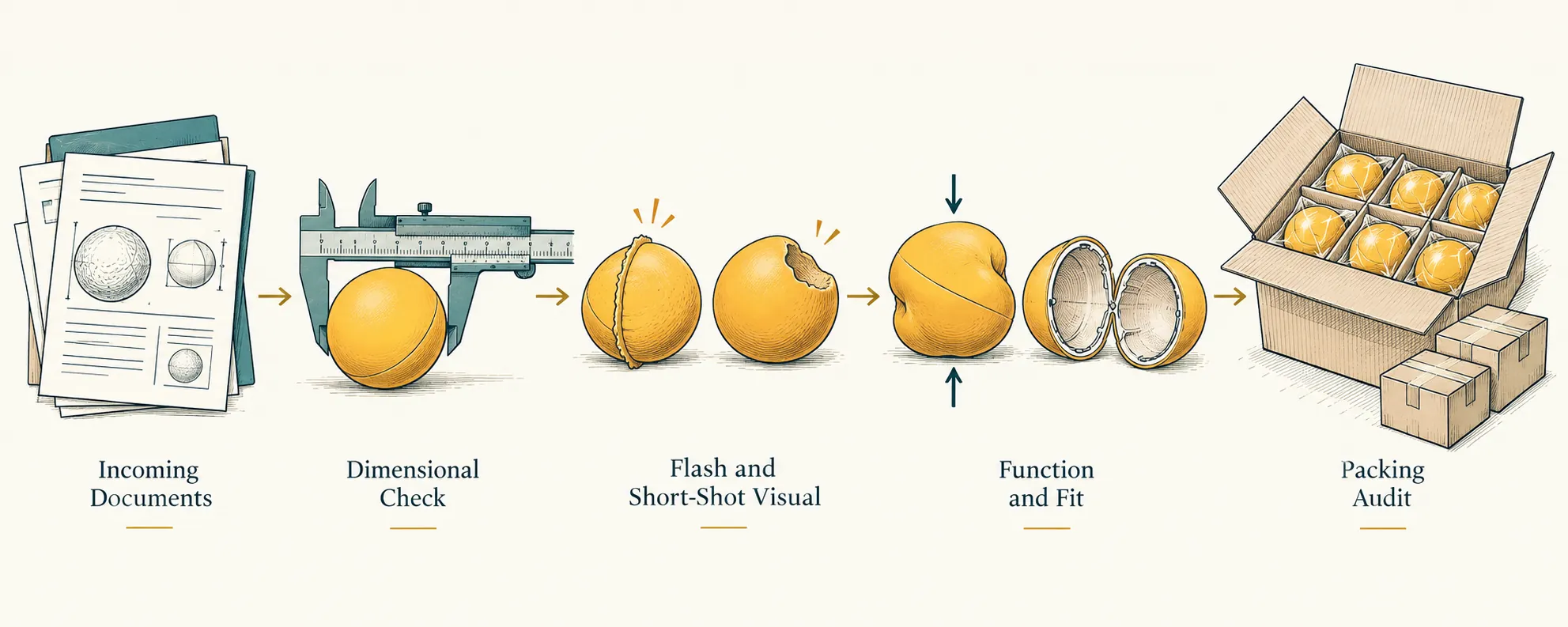
Inspect the sample in a fixed sequence: confirm its identity, check the artwork and print, examine the body and function, measure the item, and review the complete sale unit.
Confirm identity first. Match the sample identifier to the proposed item, artwork revision and written construction description. Request confirmation of the actual body material, surface finish and printing process. Appearance and touch can reveal a difference worth investigating, but they cannot verify material composition.
Check the print while the ball is relaxed. Compare wording, spelling, logo proportions, orientation, color and fine-detail legibility with the agreed artwork and color reference. Measure print width, height and position from a defined feature such as a seam or opening. Look for missing areas, blurred edges, color misregistration, smearing and print crossing a feature that was meant to remain clear.
Then observe the intended function. For a squeeze-style ball, note compression and recovery behavior, inspect the surface and seams, and compare the logo before compression, during deformation and after release. Record persistent cracking, lifting, transfer or loss of legibility. If an agreed rub or repeated-squeeze screen is used, document its method and conditions; it is a buyer-defined check, not a compliance test or a prediction of service life.
Measure the product without changing its shape through excessive measuring pressure. Record the relevant axes and the measurement method, then compare them with the written dimensions and agreed tolerances. Review the agreed packaging last: supplied contents, individual pack, label text, artwork version and packing arrangement. A loose printed ball cannot demonstrate approval of a finished retail pack.
What should a useful sample inspection record contain?
A useful inspection record connects each observation to a requirement and a decision, rather than recording only “looks good.”
Record the sample identifier, review date, reviewer, specification revision, artwork revision, sample purpose and any declared differences from production. For each check, enter the requirement, inspection method, observed result, acceptance decision and required action. Measurements belong in the record as measurements; assumptions should be labeled separately.
For print placement, for example, name the reference feature, record the measured position and compare it with the agreed drawing. For a rub check, record the contact material, whether it was dry or wet, the agreed procedure and any visible transfer. Supporting photographs are useful for orientation and defects, but a missing photograph alone does not invalidate an otherwise traceable review.
Illustrative discrepancy—not an actual order result: the specification requires the logo to clear a seam, but the sample print crosses it. Record the seam overlap as the observation and the drawing revision as the comparison record. Hold print approval, request corrected placement and inspect the replacement. Do not silently revise the requirement to match the sample.
If the buyer intentionally accepts a deviation, document its exact scope and authorization. A placement exception should not become permission to change the body, ink color or packaging.
What does the 12-hole rainbow ball record show about item-specific limits?
The 12-hole rainbow ball record illustrates why package dimensions, print feasibility and capsule fit must be confirmed separately for the actual item.
Its recorded retail-pack size is 7 x 7 x 7 cm; that is not a complete measurement of the ball itself. Measure the physical product on all relevant axes and record the package dimensions separately. A package measurement cannot establish the usable print area on the toy body. 12-hole rainbow ball record
The same record calls for item-specific review of surface printing and packaging changes rather than a universal pad-print or full-color promise. State whether the requested sample demonstrates printing on the toy body, a label, a header card or a printed box. Approval of one location does not approve the others. 12-hole rainbow ball record
Define the actual sale unit before approval: the item and everything supplied with it, including its agreed individual packaging and labeling. For capsule or vending use, this item's suitability is not established by default; evaluate the actual packed shape with the intended shell and machine. A print sample alone does not establish fit or dispensing performance. 12-hole rainbow ball record
What happens after approval or a discrepancy?
After approval, retain and identify the accepted sample with the order records; after a discrepancy, hold the affected approval until a correction or written exception is resolved.
Attach the approval scope to the purchase order and preserve the specification, artwork and change history. The 12-hole rainbow ball record likewise recommends keeping the approved version with the purchase order and recording changes before production. Protect the retained sample from handling damage or storage conditions that could compromise later comparisons. 12-hole rainbow ball record
For a correction, identify the failed requirement, request the revised sample and repeat the affected checks. Also check connected features: moving a logo may change its relationship to a seam, opening or curved surface. Do not overwrite the original discrepancy record; close it with the correction and approval decision.
At bulk inspection, select units from the production lot under the agreed inspection plan rather than relying only on a presentation sample. Compare print, dimensions, function and packed contents against the written requirements, retained reference and authorized changes. Record where inspected units came from and which characteristics were checked.
If production differs, identify the affected characteristic and scope before deciding on correction, sorting, rework or rejection under the agreed terms. One mismatch warrants investigation; it does not by itself establish that every unit is defective. Equally, one matching unit does not establish that the whole batch conforms.
Does a hand-approved sample establish safety or long-term durability?
A hand-approved sample establishes neither regulatory safety nor a verified long-term durability claim.
Keep commercial inspection separate from safety evaluation. Visual checks, squeezing and agreed rub screens can identify observable problems, but they do not replace the specified laboratory tests needed for a safety conclusion. Review destination-specific documentation separately and match its coverage to the actual construction and applicable requirements.
Use equally precise language for durability: “no visible print damage under the recorded sample check” describes an observation. “The print will last throughout use” claims an outcome the sample has not established. Approve the evidence you have—not every future order.