
Release a 50,000-piece promotional toy order against the existing 5,000-piece approval only where the approved item and presentation remain unchanged; reapprove every changed attribute. The constraint is not the extra zero—it is whether color quantities, artwork setups, packing, batch identification and shipment splits still match one controlled specification. Carry forward unchanged sample and artwork references explicitly, obtain supplier confirmation of the larger order’s packing and allocation, and close changed-item approvals before releasing the affected production.
Treat this as a purchasing control, not an automatic requirement to remake every sample or repeat every test. A quantity increase alone does not establish that the product construction has changed.
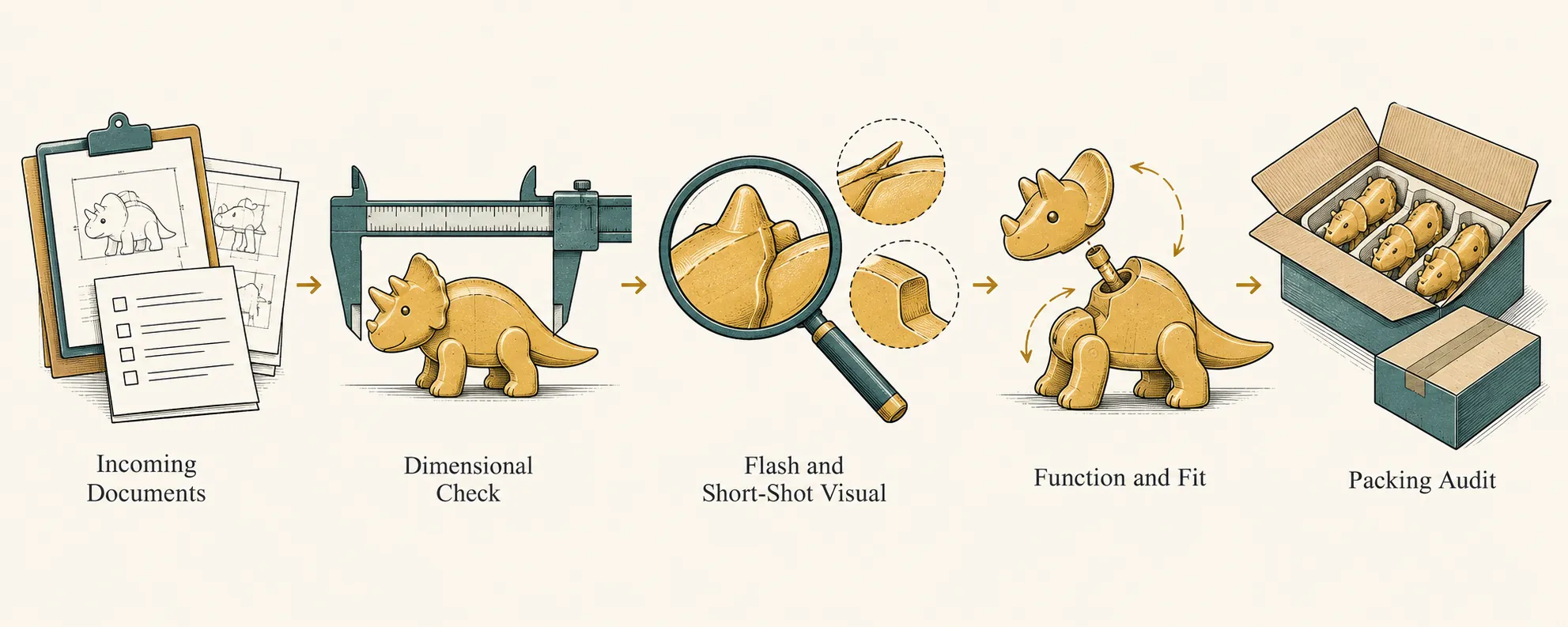
Which 5k approvals can carry forward to the 50k order?
Unchanged product and artwork approvals can carry forward by reference, but the revised order quantity and any changed allocation or execution details need fresh confirmation.
Use three statuses: “Carried forward” for an unchanged approved attribute, “Reconfirmed” for an unchanged arrangement accepted for the larger order, and “New approval” for a changed attribute. Keep the original approval attached rather than replacing it with a vague instruction to “repeat the previous order.”
Separate body-color count, quantities per body color and printed ink-color count. Increasing from two body colors to four does not automatically mean four print colors—or four chargeable setups. Ask the supplier to identify the proposed artwork versions, print locations and physical setups, then approve that configuration.
| Color quantities and shades | Reapprove the quantity schedule when the mix changes, even if every shade was previously approved. Approve a new color reference or sample when a shade changes; confirm any associated material or colorant change separately. |
|---|---|
| Artwork and printing | Carry forward unchanged artwork content and placement references. Approve revised files, print locations, ink colors or sizes. For printing on an added body color, request a representative print proof rather than assuming the earlier appearance carries across. |
| Cartons and packing | Reconfirm unchanged packing for the larger order. Reapprove changes to units per inner pack, units per carton, assortment, carton construction or marks against a revised packing specification. |
| Batch identification and shipment splits | Approve changed identification or allocation methods. Actual batch IDs and carton ranges can be populated later, but require their reconciliation before dispatch. |
What must “50,000 pieces” mean on the revised purchase order?
The purchase order should define the sale unit and its contents before stating the total quantity: one toy, one set, one display or one carton are different commitments.
Write the conversion explicitly—for example, “One sale unit = one individual toy; display packaging is not an additional sale unit.” For a construction set, distinguish one saleable set from the number of components inside it. Record inner-pack quantity, master-carton quantity, assortment and treatment of any partial carton separately.
A catalog example shows why those fields need separation. The five-color steamer baozi squishy lists “Packaging”: “Display Box” and “MOQ”: “5 cartons / 720 pcs.” Those entries do not, by themselves, establish how many toys are in each display box or the permitted color ratio. Request those item-specific confirmations before issuing the purchase order. The listed minimum also does not establish a full-carton ordering restriction. Baozi squishy catalog
Confirm assortment limits at the level where they apply: whole order, display, carton or shipment. If the item is intended for a capsule or vending machine, approve its fit in the actual intended configuration; a packaging label does not establish compatibility. Keep product dimensions separate from package dimensions, and distinguish individual weight from net or gross carton weight.
Hypothetical revised order specification: 5k versus 50k
| Order identity | Prior order: Example-5K, specification R1. Revised order: Example-50K, specification R2. R2 incorporates the unchanged product sample reference Sample-1. |
|---|---|
| Sale unit and total | 5k: 5,000 individual toys. 50k: 50,000 individual toys. One sale unit remains one toy; neither carton count nor component count is the ordered quantity. |
| Body-color allocation | 5k: red and blue, 2,500 toys each. 50k: red, blue, green and yellow, 12,500 toys each. The new allocation and added shades require approval. |
| Artwork configuration | Both orders use artwork file Art-1: one ink color in one location. The file carries forward; print proof Print-2 covers its appearance on all four body colors. Supplier setup confirmation is recorded separately. |
| Recorded packing | Both orders assume 100 toys per single-color master carton. Calculation: carton count = toy quantity ÷ 100. The 5k order has 50 cartons; the 50k order has 500 cartons. Both divide exactly, so neither has a partial carton. |
| Shipment allocation | 5k: one shipment. 50k: Split A contains 20,000 toys, including 5,000 of each color; Split B contains 30,000 toys, including 7,500 of each color. |
| Cartons by split | Split A: 20,000 ÷ 100 = 200 cartons, including 50 per color. Split B: 30,000 ÷ 100 = 300 cartons, including 75 per color. Reconciliation: 200 + 300 = 500 cartons and 20,000 + 30,000 = 50,000 toys. |
| Carton marks and batch identification | Use revised mark layout Marks-2 showing order reference, color, carton quantity, split reference, carton sequence and batch ID. Use identification method Trace-2; populate actual batch IDs and carton mappings before dispatch. |
Hypothetical 50k approval-reset sheet
| Record identity and baseline | Order: Example-50K. Reset sheet: Reset-2, dated October 28, 2026. Previous approval: Example-5K / R1 / Sample-1. Target: 50,000 individual toys to R2. Observation: the example revision register links R1, Sample-1 and all R2 attachments. Decision: baseline accepted. Approver: buyer purchasing lead, October 28, 2026. Closure: R2 issued as the controlling order specification. |
|---|---|
| Sale unit and recorded packing | Previous reference: R1 / packing drawing Pack-1. Target: one toy per sale unit; 100 toys per single-color master carton; no inner display. Observation: supplier confirmation and the example pack record match that configuration. Decision: unchanged packing reconfirmed under R2. Confirmation: supplier packing lead; approval: buyer operations lead, October 28, 2026. Closure: Pack-1 linked to R2. |
| Color quantities and references | Previous reference: R1, red and blue at 2,500 each. Target: four approved shades at 12,500 each. Observation: allocation Color-2 totals 50,000; added green and yellow references are attached alongside the retained red and blue references. Decision: new approval. Approver: buyer product lead, October 28, 2026. Closure: Color-2 signed and incorporated into R2. |
| Artwork and setups | Previous reference: Art-1 and the original print proof. Target: retain Art-1, one ink color and one location; approve appearance across four body colors. Observation: illustrative Print-2 matches the specified content and placement on all four colors; supplier setup confirmation is attached. Decision: carry forward Art-1; approve Print-2. Approver: buyer artwork lead, October 28, 2026. Closure: approved proof and setup record linked to R2. |
| Carton marks | Previous reference: original mark layout Marks-1. Target: Marks-2, including color, quantity, split, sequence and batch fields. Observation: the example populated proof contains those fields and matches the packing specification. Decision: new approval. Approver: buyer logistics lead, October 28, 2026. Closure: Marks-2 approved; actual variable data remains subject to the dispatch check. |
| Batch identification | Previous reference: original identification method Trace-1. Target: Trace-2 links each carton range to its production batch and specification revision. Observation: the example record layout supports batch-to-carton and batch-to-split mapping. Decision: method approved, not actual batch allocation. Confirmation: supplier quality lead; approval: buyer quality lead, October 28, 2026. Closure: production-method approval closed; actual mapping required before dispatch. |
| Shipment splits | Previous reference: one-shipment plan under R1. Target: Split A at 20,000 toys and Split B at 30,000, with the specified color allocation. Observation: allocation Split-2 reconciles to 50,000 toys and 500 cartons. Decision: new allocation approved; this is not a delivery-date commitment. Approver: buyer logistics lead, October 28, 2026. Closure: Split-2 signed; each dispatch record must reconcile to its allocation. |
| Release decision and follow-up | Decision: release production against R2; do not release dispatch solely on this sheet. Responsible approver: buyer purchasing lead, October 28, 2026. Follow-up owner: supplier shipping lead submits actual batch IDs, carton ranges and packing lists. Closure condition: buyer logistics lead records the dispatch review decision and date for each split; receiving records later close acceptance or identify a query. |
How should split shipments be checked and closed?
Check every shipment against both the controlling specification and its approved allocation, then reconcile the remaining balance before releasing the next split.
For each split, record the order and revision, destination, quantities by color, packing configuration, carton ranges and actual batch IDs. A shipment split is not necessarily a production batch: one batch may span shipments, and one shipment may contain several batches. Preserve that mapping rather than assigning a batch identity simply because goods leave together.
In the hypothetical example, dispatching Split A should leave a documented balance of 30,000 toys—7,500 of each color—for Split B. If a proposed substitution changes those numbers, approve the revised allocation before dispatch rather than silently borrowing from the second shipment.
Close each split with the receiving check reference, observed quantities and identity, acceptance or query decision, responsible approver and date. For a discrepancy, assign an owner and record the agreed resolution and closure date. The approval record supports traceability; physical checks against approved references provide separate evidence of what was produced and received.
The release rule is simple: retain valid approvals, reopen changed attributes, and keep production approval separate from dispatch and receipt closure. A larger order needs a checkable specification—not a blanket restart.