
Capsule fit confirms a packing arrangement; small-parts safety requires a separate assessment of the toy and its intended age group. Approve a capsule toy only when both checks are resolved for the actual sale unit. A toy that fits inside a capsule may still present a small-parts concern, while suitable safety documentation cannot establish that its packaging will close. Record dimensions and packing separately from age grading, small-parts evidence, and any applicable Children’s Product Certificate.
The regulatory references below concern US orders. For products sold in other markets, retain the same separation between packing approval and destination-market safety review.
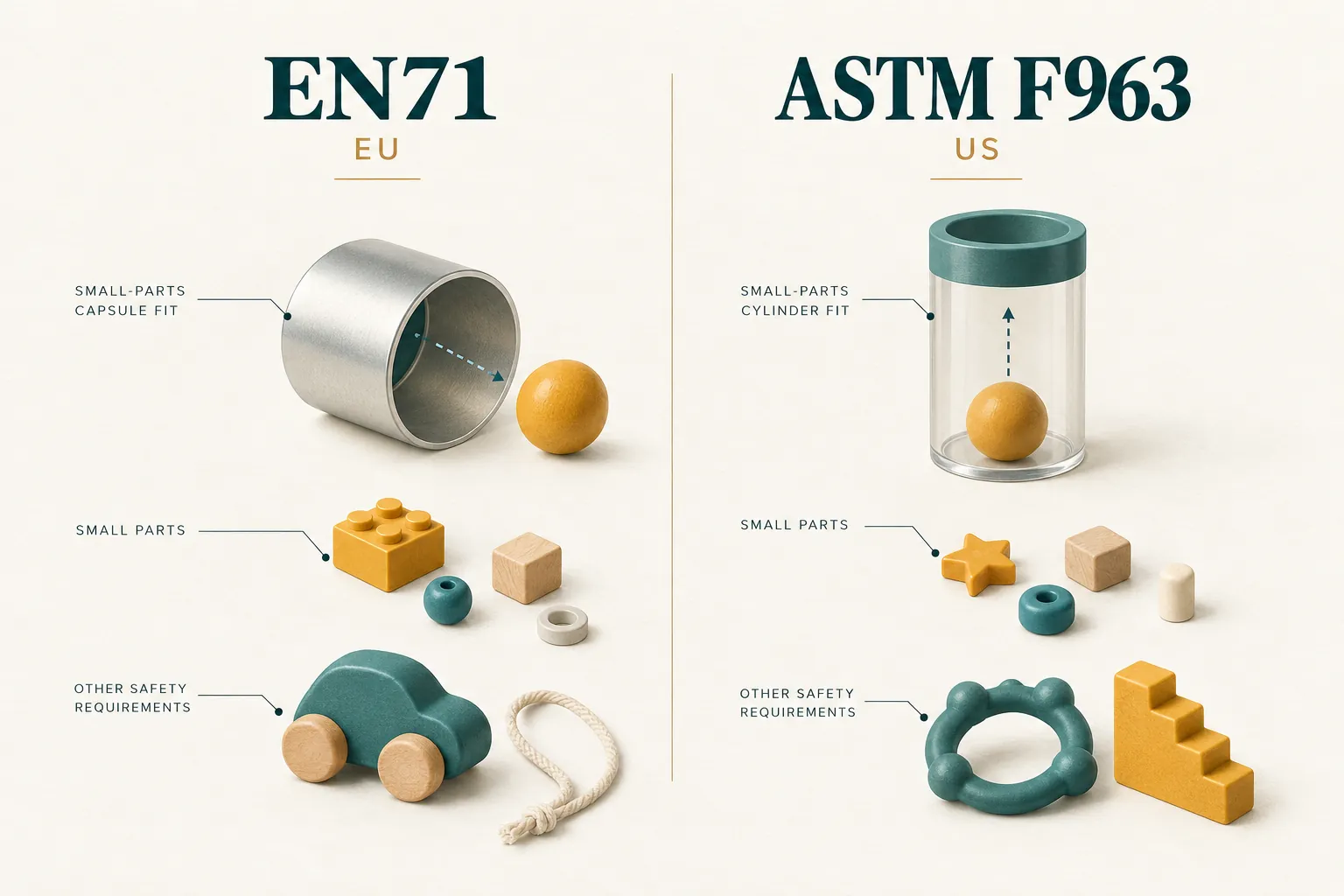
What must be confirmed before calling an item capsule-ready?
An item is capsule-ready only after its exact contents and packing arrangement have been checked against the intended capsule—not merely compared with its advertised diameter.
Define what the customer receives: one loose toy in a capsule, a wrapped toy with an insert, or a retail multipack. A 32-pack is a sale-unit count, not a dimension. Separately record how many sale units are packed in each shipping carton.
Request the item’s dimensions, the packed contents’ dimensions, and the capsule’s usable internal geometry, including its opening and closure features. Check a representative assembled sample with the intended wrapper and insert: it should load and close without unintended compression, damage, or interference. For vending use, include a dispensing check in the specified machine. These are commercial packing checks, not safety tests.
Confirm capsule fills and multipacks item by item. Do not describe a larger construction set or powered toy as capsule-ready on the strength of a category listing or carton specification.
What do these two catalog packing records actually establish?
| Crystal decompression gyro ball — Package Size (cm) | 5.9 x 5.9 x 6.4 |
|---|---|
| Crystal decompression gyro ball — Carton Quantity | 360 pcs/carton |
| Crystal decompression gyro ball — Carton Size (cm) | 61 x 36 x 40 |
| Crystal decompression gyro ball — Net Weight per Carton (kg) | 17.0 |
| Crystal decompression gyro ball — Gross Weight per Carton (kg) | 18.0 |
| Butter-cheese toy — Product Size | 14 x 4 x 4 |
| Butter-cheese toy — Carton Quantity | 540 pcs/carton |
| Butter-cheese toy — Carton Size (cm) | 59 x 43.5 x 47 |
| Butter-cheese toy — Net Weight per Carton (kg) | 18.0 |
| Butter-cheese toy — Gross Weight per Carton (kg) | 20.0 |
How should a buyer use this packing comparison?
Use the gyro-ball record to investigate packaged fit and the butter-cheese record to request product-dimension confirmation; do not treat their size fields as interchangeable.
For the gyro ball, “Package Size (cm)” describes the package, not necessarily the toy inside. If the color box remains in the capsule, check that complete package against the capsule interior. If the box is removed, obtain dimensions and confirmation for the loose toy plus the replacement wrapper, insert, and labeling arrangement.
For the butter-cheese toy, confirm the measurement unit, measurement method, and selected variant for “Product Size” before comparing it with any capsule. Then measure the complete intended fill. Do not infer flexibility or compressibility from the product name.
The carton quantities describe recorded shipping packing, not the retail sale unit or a mandatory order multiple. Net and gross carton weights are not measured individual toy weights. Neither record supports a fit calculation without the intended capsule geometry and confirmed dimensions of its contents.
What safety evidence belongs beside the fit confirmation?
The safety record should identify the intended age group, the item-specific small-parts assessment, relevant warnings, and the applicable certificate and testing references—not merely state that the toy fits.
For a US order, use the CPSC small-parts guidance to determine the restrictions and warning requirements relevant to the product and age group. A capsule dimension is not a small-parts safety determination. Review the intact toy and parts that may detach during applicable testing; an assembled toy’s outside dimensions do not settle the component question.
Request the proposed age grade and its supporting rationale, then compare them with the item’s intended use, play characteristics, packaging, and marketing. Do not treat a different age label as an administrative fix for an unresolved safety concern.
Where a Children’s Product Certificate is required, match it to the actual product and applicable rules using the CPSC CPC guidance. Compare the product identification, construction, and relevant variants with the supporting testing references. Do not assume coverage transfers to a different construction simply because the toys look alike.
Repacking requires review of the resulting sale unit, including retained instructions and warnings. It does not automatically mean every internal item code or batch needs a new test: coverage follows the tested construction and applicable rules. Route unresolved age-grading, small-parts, or certificate-coverage questions to a qualified compliance professional before approval.
How should the two-column item approval record be completed?
| FIT / PACKING — Identity: Enter item name, supplier item reference, sample or construction revision, record revision, and intended sale unit. | SAFETY / AGE GRADING — Identity: Match the same item, construction revision, sale unit, and destination market to the safety review. |
|---|---|
| Target: Specify capsule model and usable interior, contents per capsule or multipack, wrapper, insert, and required closure or dispensing result. | Target: Specify intended age group and the applicable small-parts, warning, and certificate questions to be resolved. |
| Observation: Enter measured item and packed-content dimensions with units; record assembly, closure, and any dispensing-check results. | Evidence: Enter the age-grading rationale, small-parts assessment and result, warning artwork revision, and relevant certificate or report references. |
| Recorded packing: Keep product size, package size, sale-unit quantity, Carton Quantity, carton dimensions, and carton weights in separately labeled fields. | Coverage check: Record how the documents and reviewed sample match the selected construction, variants, and final sale-unit presentation. |
| Source and date: Identify the catalog route, dimension drawing, supplier confirmation, sample reference, and observation or confirmation date. | Source and date: Identify the document issuer, document reference, relevant sample identity, and compliance-review date. |
| Status and owner: Mark Confirmed, Pending, or Rejected for this packing configuration; enter the packing approver’s name and date. | Status and owner: Mark Confirmed, Pending, or Rejected for this market and age group; enter the responsible safety reviewer’s name and date. |
| Follow-up closure: Record any required packing correction, responsible person, due date, replacement evidence, and closure approval. | Follow-up closure: Record any required safety resolution, responsible person, due date, supporting evidence, and closure approval. |
| Order decision: Enter Approve, Hold, or Reject for the identified configuration, with any conditions and the purchasing approver’s name and date. | Decision condition: Release only after both reviews are confirmed and release conditions are closed; link the final decision to both evidence records. |
When should the buyer approve, hold, or reject the item?
Approve only when both reviews are confirmed; hold when either remains unresolved; reject the proposed configuration when fit or safety review establishes that it is unsuitable.
Confirmed fit with pending safety evidence means Hold. Confirmed safety evidence with failed capsule closure means Reject that packing configuration—not necessarily the toy for every other sale unit. A revised capsule, packing arrangement, or product construction needs a corresponding review before release.
Keep the decision bounded: “approved for this item revision, sale unit, market, and age group” is more useful than “approved toy.” The record supports traceability, but it does not by itself detect an undisclosed product change.